Most people approach keyword research the wrong way. They pull up a tool, sort by search volume, and start targeting whatever looks impressive. Six months later, nothing ranks, and they cannot figure out why.
The problem is not effort. It is the wrong criteria.
Keyword evaluation is not about finding the biggest numbers. It is about finding terms your website can realistically rank for, terms your actual audience is searching, and terms that connect to something your business can deliver. When those three things align, SEO starts working.
This guide by Avira Digital Studios covers the three core evaluation criteria properly, adds two more that experienced SEOs quietly rely on, and gives you a step-by-step process you can use on any keyword from today.
Quick Answer
The three key considerations when evaluating keywords for SEO are:
- Relevance and Search Intent: Does the keyword match what your page offers, and does it match the real reason someone searched for it?
- Search Volume: How many people search for this term each month?
- Competition (Keyword Difficulty): Can your website realistically rank on page one for this term right now?
Two more factors deserve equal attention in practice:
- Execution: Do you have the resources, authority, and content quality to actually compete?
- Cohesiveness: Does this keyword belong in the topic territory your website is building?
All five are broken down below.
What is SEO, and why do keywords matter?
SEO, search engine optimization, is the work you do to make your website show up in Google without paying for ads. Good content, the right keywords, links from credible sites, solid technical foundations, it all feeds into where you appear when someone searches.
The reason it matters so much for businesses: organic search traffic arrives with intent already attached. The person found you because they were looking for something specific. That is very different from someone scrolling past an ad they did not ask for.
Keywords are how you connect your content to those searches. Get them right, and the right people find you. Get them wrong, and you spend months creating content nobody finds, or worse, content that attracts completely the wrong audience.

What is keyword in SEO?
Keywords in SEO are specific words that represent the main topics or themes of a webpage’s content. These are the terms that users commonly type into search engines when looking for any content. Relevant keywords in strategic locations on a website, such as in titles, headings, and throughout the content, help any search engines understand the page’s content. It improves the chances of the page appearing in search results for those particular queries. Effective keyword research is a fundamental aspect of SEO, enhancing a website’s visibility and attracting the right audience.
Short-Tail vs Long-Tail Keywords: Know the difference before you evaluate
Two categories come up constantly in keyword research, and understanding both changes how you assess any term you are considering.
Short-tail keywords are short, broad phrases, usually one or two words. “SEO.” “Keyword research.” Huge search volumes, fierce competition, and almost always dominated by sites that have been around for years. For a new or mid-sized website, these are not realistic targets. Not yet.
Long-tail keywords are longer and more specific, three or more words, often phrased like a question or a detailed query. “How to do keyword research for a new website.” Lower volume, yes, but far less competition, much clearer intent, and a higher likelihood that the person searching is ready to take some kind of action.
Most sites that gain early SEO traction do it through long-tail keywords. They are winnable. And because the intent is so specific, they often convert better than broad terms with ten times the traffic.
Keep this in mind throughout the evaluation process. A keyword with modest numbers is not automatically a weak choice.
The three key considerations when evaluating keywords for SEO
1. Search intent and relevance
Before anything else, before you check volume, before you look at difficulty, ask what the person searching actually wants.
Search intent is the underlying goal behind a query. Someone typing “keyword difficulty” wants an explanation. Someone typing “Semrush vs Ahrefs” wants a comparison to help them decide. Someone typing “hire SEO agency Kolkata” wants to find someone to work with. Same broad topic, completely different expectations, and Google knows the difference.
If your content does not match the intent, you will not rank. Or if you do rank briefly, users will leave immediately, sending signals back to Google that your page did not deliver. Either way, you lose.
The four types of search intent worth knowing:
The user seeks information through this intent.
Example: “What is Digital Marketing”
Keyword Selection: Focus on keywords that answer common questions or provide in-depth information related to the topic. Use terms like “what is,”. You can find short-tailed keywords here.
They are trying to reach a specific website.
Example: “YouTube login.”
Keyword Selection: These are only relevant if people are searching for your brand specifically. Targeting navigational queries for other brands is a dead end.
The user is looking to buy something but might still be in the research phase. They are comparing options before deciding.
Example: “Best keyword research tools 2026.”
Keyword Selection: You can choose keywords that indicate product reviews, comparisons, or features. Include terms like “best,” and “top-rated”.
The user is ready to make a purchase.
Example: “Hire SEO agency Kolkata“
Keyword Selection: Your service and product pages should be built around these. The page’s job is to convert, not educate.
The fastest intent check: Search the keyword yourself. Look at the first five results. Are they blog posts, product pages, comparison articles, or videos? Whatever Google is ranking tells you exactly what type of content it expects for that query. Build yours to match, not because it is a rule, but because it works.
Relevance goes deeper than intent
A keyword can match the right intent type and still be completely wrong for your website. Relevance means the keyword fits the actual subject your site covers.
A digital marketing agency could technically write a post targeting “best plumbing tools in Mumbai.” Google might even rank it. But the traffic would be useless, wrong audience, wrong context, and it would muddy Google’s understanding of what your site is actually about. Irrelevant traffic does not pay the bills.
A keyword is relevant when it belongs naturally in your subject area. For an SEO consultancy, that means terms like “on-page optimization checklist” or “how to build backlinks properly.” Not anything outside that world, regardless of the volume numbers.
2. Search volume
Search volume is the average number of times a keyword gets searched per month. It is the most looked-at metric in keyword research, and the one most likely to lead new SEOs astray.
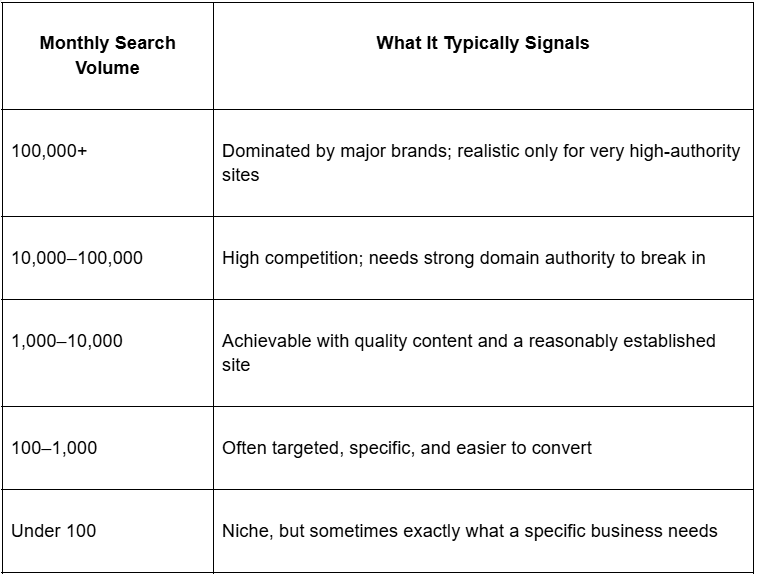
High volume is attractive. It feels like it means more traffic. But volume without context is meaningless. A keyword with 80,000 monthly searches might be completely out of reach for your site. A keyword with 400 monthly searches from people actively looking to buy might be worth more than anything with a five-figure volume.
Here is a rough way to interpret what volume figures mean in practice:
Watch out for seasonal distortion
Some keywords look strong on average but are wildly uneven throughout the year. “Christmas gift ideas” barely registers in March. “Tax return deadline” spikes for a few weeks annually. If a keyword’s volume is seasonal, factor that into your expectations, a content calendar built around seasonal peaks needs to account for the quiet months that follow.
Where to check volume
- Google Keyword Planner (free, requires a Google Ads account): a reliable starting point for volume ranges and CPC data
- Google Search Console (free): shows what people are already searching to find your existing pages
- Ubersuggest (free tier): straightforward interface, useful for initial research
- Semrush (paid): the industry standard for professional keyword work
- Ahrefs (paid): many SEOs trust its volume data more than any other tool
One metric most people overlook: CPC
Cost Per Click is what advertisers pay to appear for a keyword in Google Ads. Even if you have no interest in paid ads, CPC is a useful signal. A high CPC means businesses are spending money to reach people searching that term, which usually means the audience has buying intent. A keyword with modest search volume but a high CPC often delivers better results than a high-volume keyword with no commercial value attached.
3. Competition (Keyword Difficulty)
Keyword Difficulty, commonly abbreviated as KD, is a 0–100 score that estimates how hard it would be to rank on the first page of Google for a given term. The score is based primarily on the authority of pages already ranking, not just how many competitors there are.
A rough guide to what KD scores mean in practice:
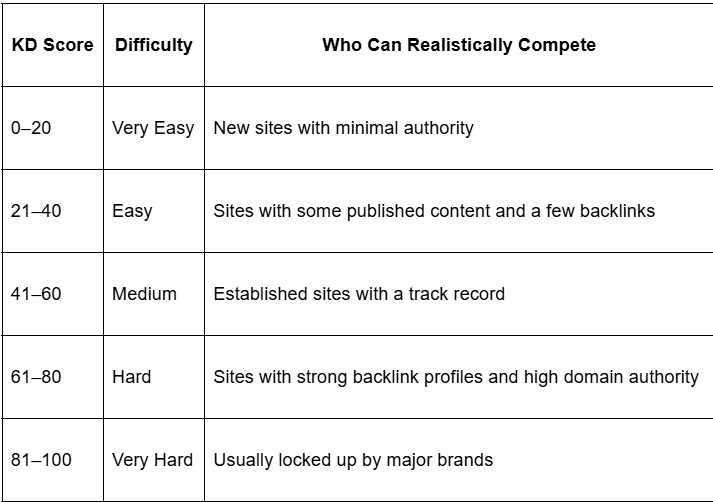
New and growing websites should focus on KD 0–30. This is not giving up on ambition, it is being strategic about it. Low-difficulty keywords are frequently long-tail terms with precise intent. Precise intent means higher conversion rates. Ranking for ten specific, achievable keywords is worth far more than chasing one competitive term for twelve months and getting nothing.
Volume and difficulty work together
Neither metric stands alone. A KD 8 keyword with 40 monthly searches might deliver less than a KD 30 keyword with 900 monthly searches, even though the second is technically harder to win. Every keyword evaluation is a judgement call that weighs both numbers against each other and against your current site’s position.
Two more factors that separate good keyword research from great keyword research
4. Execution
Here is the honest question most keyword guides never ask: even if this keyword looks perfect on paper, can you actually win it?
Execution is about your real-world capacity. Does your domain have enough authority? Can you produce content that genuinely outperforms what is already on page one? Do you have the time and budget to create something better than the top-ranking result, build links to it, and wait for it to work?
A keyword can tick every box, solid relevance, decent volume, manageable KD, and still be the wrong target if the pages currently ranking are from publications with fifteen years of backlinks behind them. Being honest about execution early saves you months of effort pointed in the wrong direction.
5. Cohesiveness
Google looks at your entire website, not just individual pages. Over time, it builds an understanding of what subjects your site covers and how much expertise it demonstrates across those subjects. This is what SEO professionals call topical authority, and it is one of the quieter, more powerful forces in organic rankings.
When your site consistently publishes content on keyword research, content strategy, on-page SEO, and technical SEO, Google starts treating it as a credible source across that topical space. Each new piece of relevant content strengthens that signal.
Publish something completely unrelated, say, a post targeting “best car insurance in India”, and you have not gained anything. You have just added a page that fits nowhere, earns no authority signal from your existing content, and sits there as an odd piece of the puzzle.
Before targeting any keyword, ask whether it belongs in the same topical neighbourhood as everything else you publish. If yes, it is a candidate. If not, it is someone else’s keyword to target.
A practical five-step evaluation process
Run every keyword you consider through these five checks before committing to it.
Step 1 – Read the intent: Search the keyword in Google. Look at what is currently ranking. What format does Google consistently reward? Match it.
Step 2 – Check the volume: Use Keyword Planner or a similar tool. Note whether the volume is stable year-round or peaks seasonally. Adjust your expectations accordingly.
Step 3 – Assess the difficulty: Pull the KD score and, more importantly, open the pages currently ranking. What sites are they? How established are they? Can your site realistically compete with them at its current authority level?
Step 4 – Test cohesiveness: Does this keyword belong in your content world? Would your target audience actually search it? If you have to stretch to justify it, that is a sign.
Step 5 – Check the CPC: A strong CPC near the keyword suggests commercial intent in the audience, even for informational content. That is a useful signal when deciding how much effort to invest.
A keyword that clears all five is worth pursuing. One that stumbles on difficulty or cohesiveness should either go on a future list or be replaced with a narrower, more achievable version of the same idea.
Common mistakes that waste good SEO effort
Going straight for the big keywords: Almost every new website tries this. Almost every new website spends months ranking on page four for nothing. Start where you can win, build authority through those wins, then move up.
Ignoring intent: Publishing an informational guide for a query where every top result is a product page is a misalignment that no amount of quality writing overcomes. Check the intent first, every single time.
Not reading what already ranks: Open the actual pages on page one before you decide to target a keyword. If they come from government portals, national newspapers, or sites with millions of backlinks, that keyword is not yours to take, not today.
Keyword cannibalization: Two pages on the same site targeting the same keyword confuse Google about which one to surface. Often, neither ranks well. Each keyword should map to exactly one page. This is keyword mapping, and sites that do it properly perform noticeably better than those that do not.
Volume as the only filter: Traffic quantity means nothing without traffic quality. Fifty searches per month from people ready to hire someone beats five thousand searches from people looking for a free definition.
Keyword research tools worth knowing
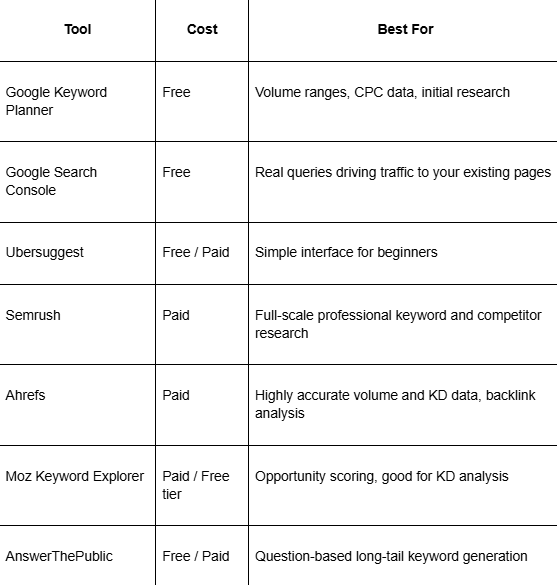
Starting out? Google Keyword Planner and Google Search Console cover the basics well at no cost. Paid tools earn their price when you are managing SEO for a business with real stakes and need data you can trust at scale.
Frequently Asked Questions
Keyword competition is a broad term, it just means how many sites are going after the same keyword. Keyword Difficulty (KD) is a specific, calculated score that measures how hard it actually is to rank, based on the authority of the pages already sitting on page one. Competition tells you there are rivals; KD tells you how strong they are.
Stay under 20 to start. Once you have been publishing consistently for six to twelve months and have earned some backlinks, moving into the 20–40 range is realistic. Breaking into 40–60 territory typically means your site has an established track record and growing authority.
No, and treating it that way is one of the most common mistakes in SEO. Intent and relevance matter more. A hundred searches per month from people who are ready to buy outperforms ten thousand searches from people who are not interested in what you sell.
It means the keyword belongs in the topical territory your website is building. Google rewards sites that go deep on a subject, not sites that scatter across everything. A keyword is cohesive if it strengthens your topical focus. One that does not fit your subject area dilutes it.
Every six months, at minimum. Search behaviour shifts, new competitors emerge, and some terms that were too difficult a year ago become winnable as your site grows. Google Search Console is your best ongoing source for this, it shows you exactly which terms are gaining traction and which need attention.
What to Read Next
If this article gave you a solid understanding of keyword evaluation, here are the natural next steps for putting it into practice:
- Organic marketing vs paid marketing: what you need to know, understanding how SEO fits into a broader marketing strategy
- SEO services in Kolkata: what they cost and what you get, if you are looking for professional help with keyword research and SEO for your business
- Local SEO for Kolkata businesses, how keyword evaluation works specifically for local search queries
At Avira Digital Studios, keyword research is the first thing we do for every client before writing a single word of content. If you are not sure which keywords your business should be targeting, get in touch with our team and we can walk you through it.
Connect With Us :
 8820717164

 https://aviradigitalstudios.com/in
Design, Development, Marketing Company in Kolkata- Avira Digital Studios :
13, Barrackpore Trunk Road, Netaji Colony, Nainan Para, Baranagar, Kolkata, West Bengal 700036