You are ready to grow your business online, but one question keeps circling back. Where should your marketing budget actually go? Do you build slowly and steadily with organic marketing, or do you pay for traffic and get results faster?
Most small business owners sit with this question far longer than they should. Some go all-in on paid ads and watch their traffic vanish the moment the budget dries up. Others commit to organic marketing and spend the first six months wondering if anything is happening at all.
Here is what most guides will not tell you upfront: this is not an either-or decision. The businesses that grow consistently online know what each channel does well and use them together deliberately. This guide will help you understand both clearly so you can make the right call for your own situation.
Avira Digital Studios is going to reveal different secret aspects of organic marketing and paid marketing. Join us on the journey of online marketing and paid marketing to grow your business exponentially.
What Is Organic Marketing?
Organic marketing is growing your online presence without paying for ad placements. Instead of buying visibility, you earn it over time through SEO, content, social media, and email.
The word “earn” matters here. When your website ranks on Google for a search term, that ranking belongs to you. Nobody can outbid you for it. Every blog post you optimise, every technical fix you make to your site, every backlink you earn, all of it builds something that keeps working for your business even when you are not actively spending money.
Think of organic marketing as a house you are building. It takes time and effort to construct. But once it is up, you are not paying rent every month to stay in it.
What Is SEO and How Does It Fit In?
SEO is simply the work of making your website easier for people to find when they search for something you offer. When someone types “affordable accounting software for small businesses” into Google and your article comes up on the first page, that click cost you nothing. Your content earned it by being more useful and more relevant than everything else on that page.
What makes SEO genuinely powerful for small businesses is the compounding effect. A well-optimised article can bring in visitors for months or years after it is published, with no ongoing spend attached to it. That is a fundamentally different relationship with traffic than paid advertising gives you.
Benefits of Organic Marketing for Small Businesses
Organic marketing is not only budget-friendly but also builds trust, ensures long-term visibility, and boosts discoverability without heavy investments. Here are several benefits of organic online digital marketing in your business.
1. Cost-effective over time:
Organic marketing requires real effort upfront, but the ongoing cost is far lower than running ads. Once you rank for a keyword, that traffic costs you nothing per click. For a business watching its margins closely, that difference adds up quickly.
2. Builds trust with your audience:
People instinctively trust organic search results more than they trust ads. Ranking naturally signals credibility in a way that a paid placement simply cannot replicate.
3. Traffic that does not disappear overnight:
When your ad budget runs out, paid traffic stops immediately. Organic traffic does not work that way. A page ranking well today can keep bringing visitors for years with only basic upkeep. You are building something you actually own.
4. Visibility across multiple channels at once:
Good content gets found through search, shared on social media, referenced by other websites, and forwarded in emails. One genuinely useful piece of content can generate reach across several channels simultaneously.
5. Flexibility without constant extra spend:
When your messaging needs to change, you update your content. With paid ads, changing direction means spending more. Organic marketing gives you room to adapt without the budget pressure.
Organic Marketing Strategies That Work
In the field of organic marketing and paid marketing, here we are discussing 5 strategies to grow your business organically.
1. Search Engine Optimization (SEO):
SEO is the foundation everything else builds on. Make sure your pages are structured clearly, your content answers what people are actually searching for, and the technical side of your site is not quietly holding you back. Every improvement you make here compounds over time.
2. Content Marketing:
It keeps you useful to your audience between purchase decisions. A well-written guide or practical how-to video answers the questions your customers are already typing into search, which means they find you at exactly the moment they need help.
3. Social Media Organic Marketing :
Social media works best when you stop treating it as a sales channel. Showing up consistently, responding genuinely, and sharing content that reflects how your business thinks turns a cold audience into a warm one over time.
4. Email Marketing:
Email marketing rewards patience more than almost any other channel. The list you build belongs to you. No algorithm change or platform update can take it away, and a subscriber who gave you their email is already telling you they want to hear from you.
5. Online Reviews and Testimonials:
Reviews and testimonials do something your own marketing cannot. When a real customer describes their experience in their own words, it carries a weight that no claim you make about yourself ever will. Ask at the right moment and keep them recent.
Having explored various aspects of organic marketing, let’s now dive into the realm of paid advertising to gain a comprehensive understanding of organic marketing and paid marketing.
What Is Paid Marketing?
Paid marketing means spending money to get in front of an audience right now. Google Ads, Facebook and Instagram campaigns, display advertising, remarketing, all of it falls under this umbrella.
Think of paid marketing as a turbo boost. Launching a new product? Running a limited-time offer? Need visibility on a competitive keyword while your organic rankings are still building? Paid ads can deliver all of that immediately.
The moment a campaign goes live, traffic starts coming in. Results are fast, measurable, and highly targeted. You can reach exactly the type of person you want based on their location, interests, behaviour, and what they are actively searching for.
But there is a catch every small business owner needs to understand: when you stop paying, the traffic stops. Every click costs money, and costs tend to rise over time as more competitors enter the same auction. Paid marketing alone is a treadmill. You have to keep running just to stay in the same place.
Benefits of Paid Marketing for Small Businesses
In the dynamic world of small business marketing, paid advertising emerges as a powerful tool, offering immediate visibility and precise audience targeting.
1. Immediate Visibility:
A well-set-up campaign can bring targeted traffic to your website on the same day it launches. For a new business that needs customers quickly, this is genuinely useful.
2. Precise Targeting:
Paid platforms let you reach people by location, age, interests, and behaviour in ways organic marketing cannot match directly. You can even retarget people who have already visited your site.
3. Clear, measurable data:
Every paid campaign tells you exactly what happened: how many saw the ad, how many clicked, how many converted, and what each conversion cost. This makes it straightforward to cut what is not working.
4. Budget flexibility:
You decide how much you spend. Start small, find what works, and scale from there. You can pause at any time without any lasting damage to your marketing infrastructure.
5. Short-term competitive edge:
Even if a competitor has years of organic authority, paid ads can still put your business in front of their potential customers. For newer businesses in competitive markets, that kind of visibility matters while the organic foundation is still being built.
Paid Marketing Strategies Worth Knowing
Paid marketing strategies encompass various approaches to promote products, services, or brands through paid channels. Here are five effective paid marketing strategies:
1. Google Adwords Pay Per Click Campaign :
Google Ads is where most small businesses should start with paid marketing. Your ad shows up at the top of search results when someone looks for exactly what you offer, and you only pay when they click. The reason it works so well is timing. The person searching is already looking for a solution. You are simply making sure your business is the first one they see.
2. Paid Social Media Ads:
Social media ads on Facebook, Instagram, and LinkedIn work differently. People are not searching for you, they are scrolling. That means these platforms are better suited for building awareness and staying visible with an audience that does not know you yet. If your goal is to get in front of a cold audience before they start comparing options, social ads are where that conversation begins.
3. Display Advertising:
In paid marketing, display visually appealing banners or video ads on websites or apps to capture the attention of a broader audience. This paid marketing strategy enhances brand visibility across various online platforms.
4. Remarketing Campaigns:
Remarketing is one of the most underused tools available to small businesses. When someone visits your website and leaves without taking action, remarketing lets you follow up with ads on other platforms they use. These people have already shown interest, which is why remarketing consistently delivers better returns than campaigns aimed at people who have never heard of you.
5. Influencer Marketing:
Influencer partnerships work best when the creator’s audience genuinely matches your ideal customer. It is not about follower counts. A smaller creator with a highly engaged, relevant audience will almost always outperform a larger one whose followers have no real interest in what you sell. For product-based businesses especially, the right partnership can build trust with a new audience faster than a paid ad ever could.
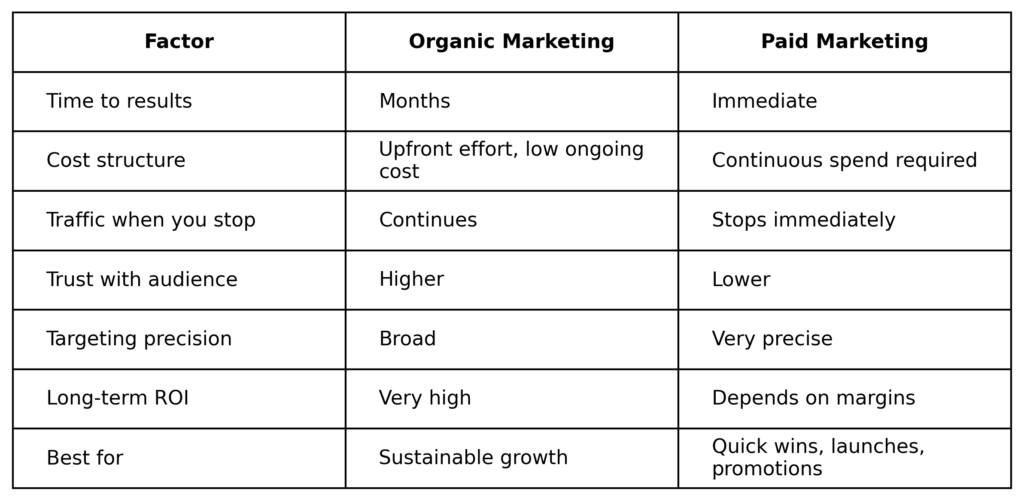
Organic vs Paid: A Direct Comparison
How to Use Both Together
The businesses that get the best long-term results do not pick one channel and ignore the other. They use paid and organic together in a sequence that makes each one stronger.
Start with paid to test what converts:
When you are starting out, you do not know with certainty which keywords or messages will resonate. A small, focused paid campaign gives you real data quickly. You can see which keywords drive actual conversions rather than guessing.
Feed that data into your organic strategy:
Take what performed well in paid and build your long-term SEO content around those same terms. You are no longer guessing about what your audience responds to. Now build content that earns those same clicks for free over time.
Use organic growth to reduce paid spend:
As your rankings build, pull back paid spending on terms you already rank for organically. Redirect that budget toward new campaigns or harder keywords where you still need the visibility push.
This is how marketing becomes a compounding asset rather than a monthly expense. Paid gives you speed. Organic gives you permanence. Together, with a clear plan behind them, they give you both.
Which One Should You Start With?
New business with limited budget:
Run a small paid campaign to get your first customers and learn what converts. At the same time, start publishing SEO-optimised content consistently so the organic foundation begins building in the background.
Established business with little organic presence:
Make SEO your primary focus. The compounding returns over 12 to 24 months will meaningfully reduce your dependence on ad spend.
Already running paid ads that are working:
Start investing a portion of that budget into organic content. You are building an asset alongside the ad spend rather than simply running a permanent cost.
The right answer depends on where your business is right now. But for almost every small business, ignoring one channel entirely is the one move that rarely pays off.
Frequently Asked Questions
Is organic marketing free?
Not exactly. You are not paying for ad placements, but there is real investment in time, content creation, and often professional SEO work. The difference is that what you build organically stays with you. You are investing in an asset rather than renting traffic.
How long does SEO take to show results?
For most small businesses, meaningful organic traffic from SEO begins appearing within three to six months. Becoming a significant traffic source typically takes twelve to eighteen months. Starting early and staying consistent is what makes the difference.
Can a small business afford paid advertising?
Yes, with the right approach. You do not need a large budget to run effective campaigns. Starting focused and targeted on one platform with a modest daily budget lets you learn what works before committing more. The goal is spending smarter, not spending more.
What is the biggest mistake businesses make with paid ads?
Running campaigns without any organic foundation behind them. If someone clicks your ad and lands on a thin website that has no social proof and no clear reason to trust you, the spend is wasted. Building some organic credibility first makes every paid campaign perform better.
You can’t pick just one type of marketing from organic marketing and paid marketing because both organic and paid marketing have different benefits. If you ignore organic, your costs might go up to get traffic. But if you only focus on organic, your growth could be slow. So, it’s smart to use both. Allocate your resources to take advantage of both organic and paid marketing to get the best results for your business.
If you want to know more about design, development, and marketing you can follow the official blog page of Avira Digital Studios.
What to Read Next
- What are three key considerations when evaluating keywords for SEO — before you run any organic or paid campaign, keyword evaluation is the starting point
- SEO services in Kolkata: what they cost and what you get — if you want professional help building your organic presence
- Local SEO for Kolkata businesses — how organic search specifically works for locally-focused businesses
At Avira Digital Studios, we work with small businesses to build organic marketing strategies that reduce long-term dependence on paid advertising. If you want to understand what that would look like for your business specifically, get in touch with our team for a free consultation.
Connect With Us :
 8820717164

 https://aviradigitalstudios.com/in
Design, Development, Marketing Company in Kolkata- Avira Digital Studios :
13,Barrackpore Trunk Road,Netaji Colony, Nainan Para, Baranagar, Kolkata, West Bengal 700036