Remember when SEO meant typing the same word over and over until Google noticed? Those days are dead.
In 2026, search engines don’t just process queries; they interpret intent, context, and nuance. Large Language Models now decode what you really mean when you type a query. The frustration. The intent. The unspoken questions.
Here’s what we’re watching at Avira Digital Studios: businesses still playing the old game are disappearing from search results. The ones winning? They’ve partnered with an SEO Expert in India who understands this AI-driven landscape.
Algorithms have changed, but strategy is still human.
What are Large Language Models? Understanding the technology behind AI search
To understand where SEO is headed, we must first demystify the engine driving the change: Large Language Models.
How LLMs work in simple terms
At their core, LLMs are advanced AI systems trained on massive amounts of text data—think of them as having read a significant portion of the internet. They don’t “know” facts in the way a database does; instead, they understand the statistical relationships between words. This allows them to predict what word comes next in a sequence, enabling them to write essays, answer questions, and summarize complex topics with startling accuracy.
Role of natural language processing in modern SEO
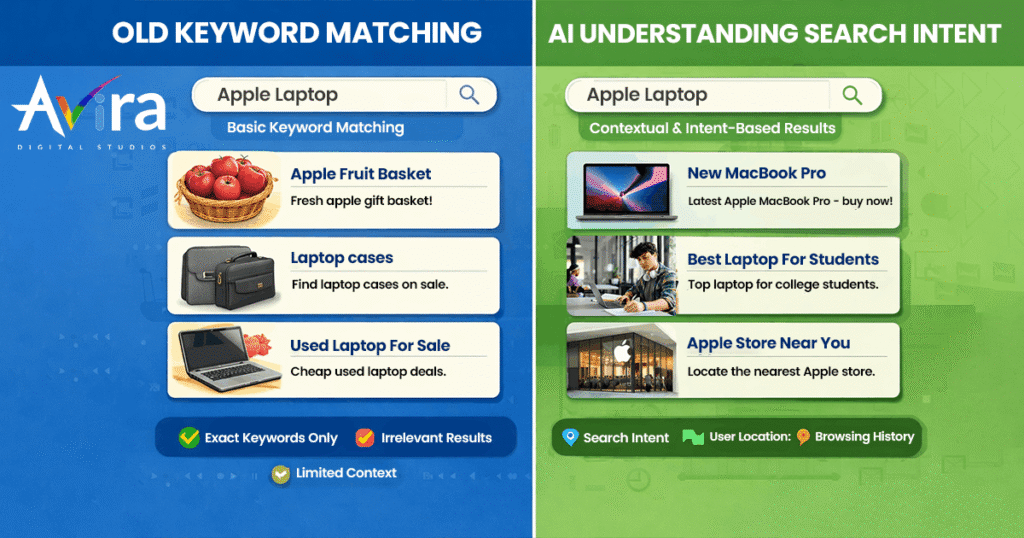
This capability hinges on Natural Language Processing (NLP). NLP is what allows machines to read and interpret text the way a human would. For SEO, this means search engines no longer just look for the phrase “best coffee shop.” They understand a query like, “Where can I get a quiet latte to work from in Park Street?” by parsing the intent (working, quiet) and the location (Kolkata).
Evolution from traditional algorithms to AI-driven search
Remember when SEO was about stuffing keywords into meta tags? That feels like ancient history. We moved through link-building arms races to the era of “mobile-first indexing.” Now, we are in the age of AI-first reasoning. Traditional algorithms follow rules; AI algorithms follow understanding. This evolution has paved the way for massive shifts in how Google ranks content.
Impact of LLMs on search engines and Google ranking factors
If you’re a business owner, the algorithms of 2026 look very different from those of 2020. In the era of AI in SEO 2026, rankings are no longer determined by optimization alone but by how effectively content satisfies real user intent.
How AI is changing search engine algorithms
Search engines are now “thinking” engines. They are using LLMs to assess the depth of a topic covered on a page, not just the presence of a keyword. Google’s systems can now judge whether your article on “keto diet” truly explains the science, addresses common pitfalls, and provides better value than another article. It is a subjective quality assessment driven by AI.
Google AI search updates and SGE explained
The biggest game-changer is the continued integration of AI into the search results page itself. Google’s Search Generative Experience (SGE) provides AI-crafted answers directly at the top of the page. For users, this is incredible; they get instant answers. For websites, it means the battle is no longer just for the #1 spot, but for being the source cited in that AI-generated overview. If you aren’t cited by the AI, your traffic could plummet.
Semantic search and user intent recognition
This all boils down to semantic search. Google is now a master at reading between the lines. If a user types “sprained ankle fast recovery,” the search engine knows they likely want a timeline for healing, exercises to do, and warning signs of complications. Modern SEO demands that your content answers these unspoken questions, not just the typed keyword.
AI content creation: Can LLM-generated content rank on google?
A burning question on every marketer’s mind is: “Can I just let AI write my content for me?” The answer is both yes and no.
Benefits of using LLMs for content writing
There is no denying the power of AI as a tool. It can overcome writer’s block, generate outlines in seconds, and research data points faster than any human. For an SEO Expert in India, LLMs are like a high-performance power drill; they make the job faster and more efficient. They allow for the rapid creation of content hubs and FAQ sections that would take a human team weeks to produce.
Risks of AI-generated content for SEO
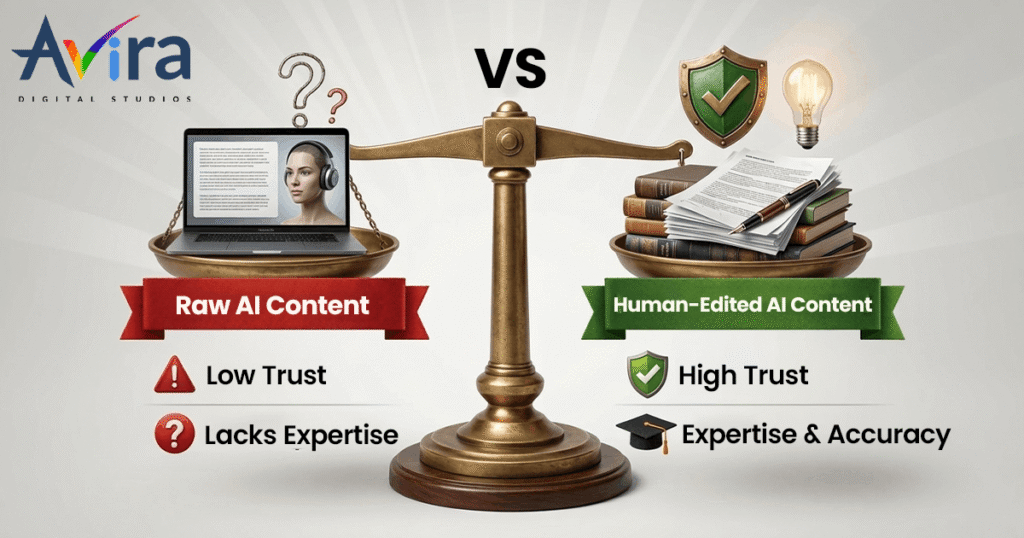
However, handing the keys entirely to AI is a dangerous gamble. Unedited, generic AI text lacks a “point of view.” It sounds like everyone else because it was trained on everyone else. In a world flooded with AI content, blandness is the kiss of death. Google’s algorithms increasingly favour content that demonstrates depth, originality, and real-world perspective. These are the qualities often missing from unedited AI-generated text.
Google E-E-A-T guidelines and AI content quality
This is where Google’s E-E-A-T (Experience, Expertise, Authoritativeness, Trustworthiness) comes into play. AI has no real-world experience. It can’t tell you what it felt like to start a business or the specific taste of a family recipe. The content that will thrive in 2026 is “human-edited AI content.” It uses the efficiency of the machine, but it is layered with human anecdotes, original data, and a unique voice; a process that requires strategic oversight from experts.
How LLMs are changing keyword research and search behaviour
The tools of the trade have also evolved. Keyword research is no longer just about volume. LLMs are transforming keyword discovery, intent interpretation and understanding search behaviour.
AI-driven keyword research tools
Modern tools powered by LLMs don’t just show you “related keywords”; they show you “related topics” and “user questions.” They analyze millions of search queries to cluster them by intent, helping you build topic authority rather than just chasing individual terms.
Predictive search trends using LLM data
LLMs are brilliant at spotting patterns. They can analyze social media chatter, news trends, and search data to predict what people will be searching for next month. This allows forward-thinking businesses to create content that is ready and waiting when the demand spikes; a practice known as “newsjacking” or trend prediction.
Understanding user intent with AI models
We’ve moved beyond “Informational, Navigational, Transactional” intent. In 2026, we look at “emotional intent.” Is the user anxious? Curious? Ready to buy? LLMs analyze the sentiment of search queries, allowing you to tailor your landing page copy to match the user’s emotional state.
Role of an SEO expert in India in the age of AI
With all this automation, is the human SEO expert obsolete? Absolutely not. In fact, their value has skyrocketed.
How SEO experts in India are adapting to LLM-driven SEO
The best professionals have shifted from being “keyword placers” to “strategy architects.” They are the ones who know how to prompt the AI correctly, how to fact-check its output, and how to build a brand narrative that resonates with both humans and search bots.
Human strategy vs AI automation in SEO
AI handles the data; humans handle the psychology. An algorithm can tell you that your site speed is slow, but a human strategist understands that a slow site is costing you the trust of a potential customer. AI identifies the what; an SEO Expert in India determines the why and the how.
Why businesses still need an SEO expert in India
The global nature of business requires a nuanced understanding of different markets. An SEO expert in a specific region understands local search nuances, cultural sensitivities, and language variations that a global LLM might miss. They act as the bridge between cold AI logic and warm human connection. This is the sweet spot where we excel, that is, blending cutting-edge tech with human intuition.
AI SEO strategies used by the best SEO experts in India
So, what does this modern strategy look like in practice? Here are some of the most effective AI SEO strategies to consider.
AI-Powered content optimization techniques
This goes beyond adding keywords. It involves using AI tools to analyze the “topical map” of a subject. If you are writing about “digital marketing,” the AI will suggest you also need to cover “marketing funnels,” “CTR optimization,” and “retargeting strategies” to fully satisfy the search engine that you are an authority on the topic.
LLM-based technical SEO audits
AI is now used to simulate how Googlebot crawls a site, predicting rendering issues and JavaScript errors before they become problems. It can analyze user behaviour data (click maps, scroll depth) at scale to suggest UX improvements that directly impact rankings.
Data-Driven Link Building With AI Insights
Finding high-quality backlinks used to be a manual, tedious process. Now, LLMs can analyze the entire backlink profile of a competitor, identify “link gaps,” and find journalists and bloggers who are statistically most likely to be interested in your specific story or data point.
These developments are just early indicators of the future of SEO with AI; a search landscape driven by intelligence, context, and personalization.
Future of SEO with AI: What to expect beyond 2026
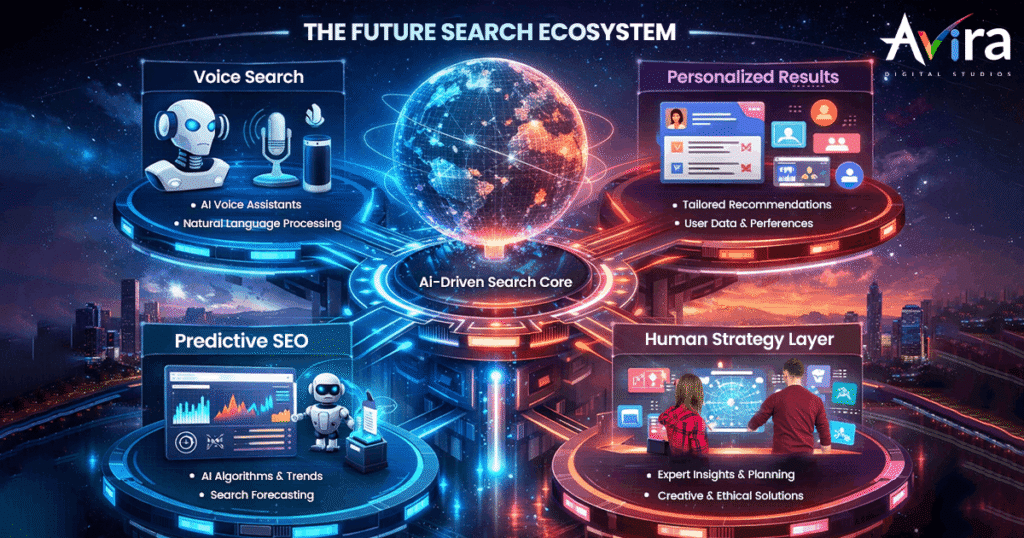
Looking further ahead, the trends are pointing toward a hyper-personalized web. The following will guide the future of SEO:
Voice search and conversational AI SEO
As smart speakers and AI assistants become ubiquitous, search queries will become longer and more conversational. Ranking for “weather Kolkata” is easy. Ranking for “Hey AI, what should I pack for my trip to New Zealand next week?” requires content that understands weather, fashion, and travel advice.
Personalized search experiences
Search results are becoming unique to the individual. An AI considering your search history, your location, and even your past purchase behaviour will tailor the results specifically for you. This makes brand loyalty and direct traffic more important than ever, as the algorithm favours sites you’ve engaged with before.
Predictive SEO and automation trends
We are moving toward a state where routine SEO tasks are fully automated. This frees up human experts to focus on creativity, campaign strategy, and building genuine brand authority.
Challenges and ethical concerns of using LLMs in SEO
It’s not all smooth sailing. The integration of AI brings significant responsibility. Below are some key challenges businesses face when using LLMs in SEO:
AI bias and content accuracy issues
LLMs are trained on the internet, and the internet contains bias and misinformation. Blindly trusting AI content can lead to publishing inaccurate or offensive material. Human oversight is critical to ensure factual accuracy and brand safety.
Over-Automation risks in SEO
If every business uses the same AI tools to write the same kind of content, the internet becomes an echo chamber. The brands that stand out will be those that use AI as a foundation but build a unique house on top of it.
Maintaining human creativity in AI SEO
Data cannot replicate creativity. It cannot invent a new brand voice or come up with a viral marketing campaign concept. The “soul” of a brand is the one thing that must remain 100% human.
How businesses can leverage AI with the help of an SEO expert in India
Navigating this landscape alone is daunting. This is why businesses rely on SEO experts to guide their AI strategy.
Choosing the right AI SEO strategy
There is no one-size-fits-all solution. A local bakery needs a different AI strategy than a global SaaS company. An expert can analyze your business goals and tailor an AI toolkit and strategy that aligns with your specific objectives.
Combining human expertise with LLM tools
The winning formula is “Human-Led, AI-Augmented.” The human sets the vision, the AI handles the heavy lifting, and the human polishes the final product. This synergy is where true ROI is found.
Scaling organic growth with AI-driven SEO
The ultimate goal is scalable, sustainable growth. By automating the mundane and amplifying the strategy, businesses can grow their organic footprint faster than ever before, provided the core strategy is sound.
Conclusion: The future belongs to AI-augmented SEO experts

Some see AI and panic. We see opportunity.
Yes, search changed and algorithms have evolved. But here’s what remains true: machines don’t build trust. They don’t understand culture, emotion, or the quiet doubts your customers feel before buying.
That’s where a genuine SEO Expert in India steps in.
At Avira Digital Studios, we’ve watched Large Language Models (LLMs) in SEO transform search from a keyword game into a human connection game. The bar is higher now. Mediocre content dies faster. But real expertise? It shines brighter than ever.
Here’s what actually matters in 2026:
- LLMs now power search. Google reads intent, not just keywords.
- AI content needs human editing. Raw text sounds generic. Human insight builds the trust Google rewards.
- Local expertise still wins. A local SEO expert in India brings market understanding that no global algorithm can replicate.
- Strategy beats budgets. Smart, human-led SEO outperforms brute-force automation every single time.
- You don’t need to choose between AI and human strategy. You need both. The data side and the people side.
If you’re ready to stop chasing algorithms and start building something that lasts, let’s talk. Because the future doesn’t belong to AI alone. It belongs to those who know how to use it.
Ready to future-proof your growth? Connect with us today.