
A strange phenomenon started appearing in analytics reports across industries last year. Traffic dropped for businesses that hadn’t lost rankings. Keywords holding the first position delivered fewer visitors. The rankings remained intact, but the clicks had vanished. Digital marketers were left scrambling for explanations while executives demanded answers.
This wasn’t an algorithm penalty. The search engines had evolved, and the old rules of visibility no longer applied. Any SEO Expert in India watching these patterns unfold could see the shift coming. Avira Digital Studios recognized early that traditional metrics were becoming unreliable indicators of actual visibility. The game had changed beneath everyone’s feet.
Want a complete roadmap to ranking higher and driving real traffic? Explore our “Ultimate SEO Blueprint for 2026“
What is LLM-Powered search and how it works
Modern search engines no longer match keywords with pages in a simple way because AI-driven search algorithms now interpret context, intent, and relationships between concepts. When a user enters a query, the search system now processes it through a Large Language Model, an advanced AI trained on large volumes of text that can understand nuance, context, and conversational intent.
These systems rely on Retrieval-Augmented Generation. You can think of it as a research assistant that searches available information, finding the relevant sources, and summarizing them into a logical reply. The LLM locates relevant information, processes it, and generates an answer directly within the search interface.
No click is required, and often no website visit is necessary. The response often appears complete, sometimes even including citations from sources the AI considers reliable.
This creates an existential challenge for businesses that built their digital presence around traffic generation. The playbook of the last decade is being rewritten, something any SEO Expert in India can clearly see while tracking global search trends.
Want to see LLMs in action? Discover how they’re already reshaping the way websites rank, get discovered, and win traffic. Read: “How Large Language Models Are Transforming SEO in 2026”
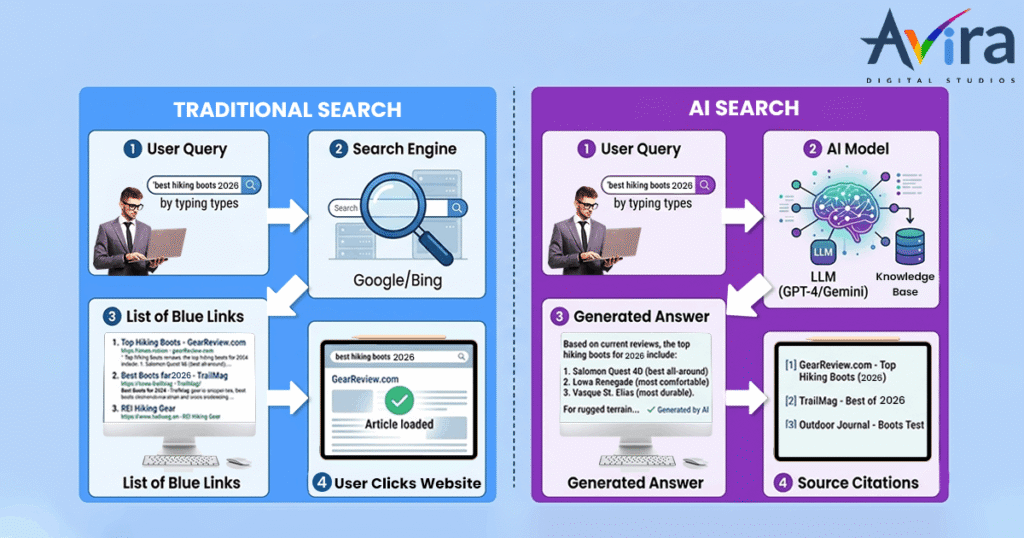
Why businesses need to optimize content for AI search
The statistics paint a stark picture. For informational queries, zero-click rates in some studies now approach eighty-five percent. Users get their answer and move on without ever visiting the source website.
This creates a paradox. If nobody clicks, how does anyone know your content exists?
The answer lies in where value now accumulates. The consideration process happens inside the AI response. When a potential customer asks, “Which CRM works best for Indian small businesses?” The AI generates an answer that shapes their perception before they ever visit a website.
This is why AI search optimization has moved from experimental to essential. The goal isn’t just clicks anymore. It’s the source the AI quotes when it builds those answers.
How LLMs are changing traditional SEO strategies
Traditional SEO built its foundation on keywords and backlinks. It was predictable, measurable, and effective for nearly two decades.
Large Language Models haven’t demolished those pillars, but they’ve added new requirements. This shift is forcing marketers to rethink SEO for AI search engines, where content must be structured for retrieval and citation.
Traditional SEO treated websites as destinations. LLM SEO treats your content as a source. The goal is to be so useful, so quotable, that the AI can’t construct a comprehensive answer without including you.
This shift from destination to source requires rethinking content strategy entirely. The rules changed. Your strategy should too. Still weighing SEO against paid ads? Get clarity here, “long-term SEO strategies vs short-term tactics“
Key strategies to optimize content for LLM-Powered search
Several approaches consistently improve visibility in AI-generated answers, especially when content is structured with AI retrieval in mind.
Content must answer questions directly. Too many businesses bury answers behind introductory paragraphs. The answer to “how much does this cost” should appear in the first paragraph, not the fifth.
Visibility in LLM responses often depends on appearing in sources that AI already trusts. Wikipedia, established publications, educational institutions, and reputable discussion platforms carry weight that standard business blogs don’t.
Businesses need new measurement frameworks. Tools now exist that poll LLMs directly, tracking which sources appear in responses. If competitors show up while you don’t, that gap represents content that needs improvement.
Off-page visibility matters more than ever. Generative search optimization requires presence in industry publications, expert roundups, and authoritative directories.
Most businesses optimize for one layer of search. The ones winning in 2026 are optimizing for three. Find out how SEO, AEO and GEO work together and where your content strategy might have a blind spot.
How to structure content for AI search engines
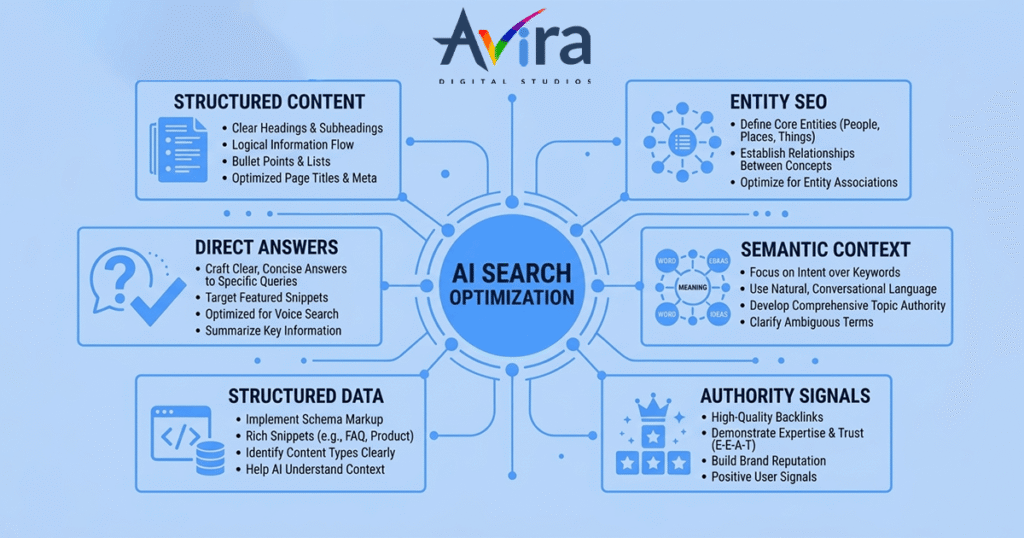
Structure has become as important as substance. Effective content optimization for AI now requires clear formatting, logical hierarchy, and easily extractable information.
The inverted pyramid model from journalism offers a useful template. Put the conclusion first. Put supporting details second. AI systems scan from the top, and they’ll take the first clear answer they find.
Headings should mirror actual user questions. Not clever variations. The exact words people type when they need answers.
Short paragraphs help. Bullet points help. Bold text highlighting key terms helps. These aren’t just readability features anymore. They’re structural signals that tell LLMs which parts of your content carry weight.
Every page should be designed as a collection of potential answers. AI systems might pull one sentence and present it as definitive. That sentence needs to work in isolation.
Best practices to rank in AI-Powered search engines
Several practices consistently improve performance in AI-powered search engines.
Technical fundamentals still matter. Sites that load slowly or block crawlers cannot be retrieved.
Entity optimization has replaced keyword density. AI systems build knowledge graphs mapping relationships between concepts. Content that clearly establishes these relationships helps LLMs position you correctly.
Authority signals have evolved. Links still help, but mentions in trusted sources help more. Being quoted in industry publications establishes the kind of authority AI systems recognize.
Writing for humans remains the most effective long-term strategy. AI systems are trained on human preferences. Content that genuinely helps people will eventually be recognized. The best strategy to optimize content for AI search is still to provide the most useful answer for real people.
Content strategies for generative AI search in 2026
An emerging approach deserves attention. Some businesses now create pages designed primarily for AI consumption. These pages prioritize machine readability and often contain dense structured data. They list specifications in formats AI systems can parse instantly.
These aren’t traditional landing pages. Instead, they are designed to be retrieved and cited when AI assistants answer comparison questions.
As AI shopping assistants become more sophisticated, this approach will grow in importance. When an AI agent researches product specifications, it needs clean, unambiguous data. Businesses that provide it become default sources.
The role of structured data and context in AI search
Schema markup has moved from optional to essential.
In traditional search, structured data enhanced listings. In AI-powered search, it provides translation between human content and machine understanding. When an AI system encounters schema markup, it doesn’t guess what numbers represent. The markup tells it directly.
This elimination of ambiguity impacts citation frequency. AI systems prefer sources requiring less work to understand. Schema.org vocabulary has now become a competitive advantage when optimizing for AI search ranking factors.
The future of SEO with LLM-Powered search
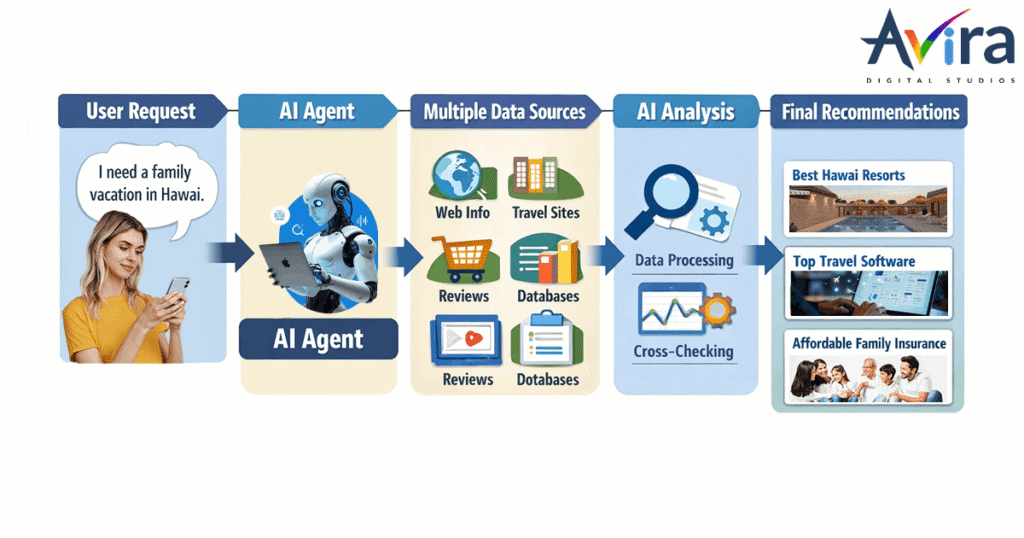
The trajectory points toward agentic search, which will shape the future of SEO with AI over the next decade. Users won’t just ask questions. They’ll delegate tasks to AI agents that execute complex workflows across the web.
AI agents will handle tasks like planning a vacation within budget, finding software that meets technical requirements, or comparing insurance policies to recommend the best option.
For businesses, this means competing for inclusion in automated workflows. AI agents will retrieve information, synthesize options, and make recommendations without human interaction with the businesses involved.
This future is nearer than it appears. The language models exist. The retrieval systems exist. The agent frameworks are being built now.
FAQs about optimizing content for AI search
- How do AI search engines use large language models to understand content?
They retrieve content first, then analyze it for meaning. The LLM processes what you’ve written, understands it in context, and extracts relevant pieces for generated answers.
- What is generative AI search and how does it impact SEO?
It creates synthesized answers rather than listing links. This reduces click-through rates but increases the importance of being cited as a source.
- How can structured content improve visibility in AI-driven search results?
Structured content reduces the work AI systems must do. Clear headings, bullet points, and schema markup make extraction easier. Less work means higher citation probability.
- Why is semantic search important for AI-powered search engines?
Because words carry multiple meanings, semantic understanding helps AI systems determine which meaning applies in each situation, making search feel intelligent rather than mechanical.
Conclusion
The business with declining traffic despite steady rankings represents a challenge facing countless organizations. The old metrics no longer tell the complete story. Visibility now means being present in the answers AI systems generate, even when those answers don’t produce immediate visits.
The path forward requires accepting this new reality. Structure content for retrieval. Write answers that stand alone. Build authority in places AI systems trust. Track citations as carefully as you once tracked clicks.
For any SEO Expert in India or a global brand, the mandate is clear. At Avira Digital Studios, we’ve spent the last two years helping businesses navigate exactly this transition, rebuilding strategies around AI visibility rather than yesterday’s metrics. The AI is listening. The question is whether your content is saying anything worth repeating.
Ready to make your brand the source AI engines trust? Contact us today for a free AI visibility audit and discover where you stand in the new search landscape.