Starting a business often means pouring everything into the product. The assumption is that quality sells itself. But months pass, and the cart stays empty because customers aren’t mind readers. They need to see, touch, and feel what you stand for. That’s where collateral in marketing enters the frame.
In simple terms, marketing collateral explains your business clearly so customers understand and trust what you offer. And when that translation is intentional, shaped by both strategy and craft, it becomes creative marketing collateral design.
What is Collateral in Marketing?
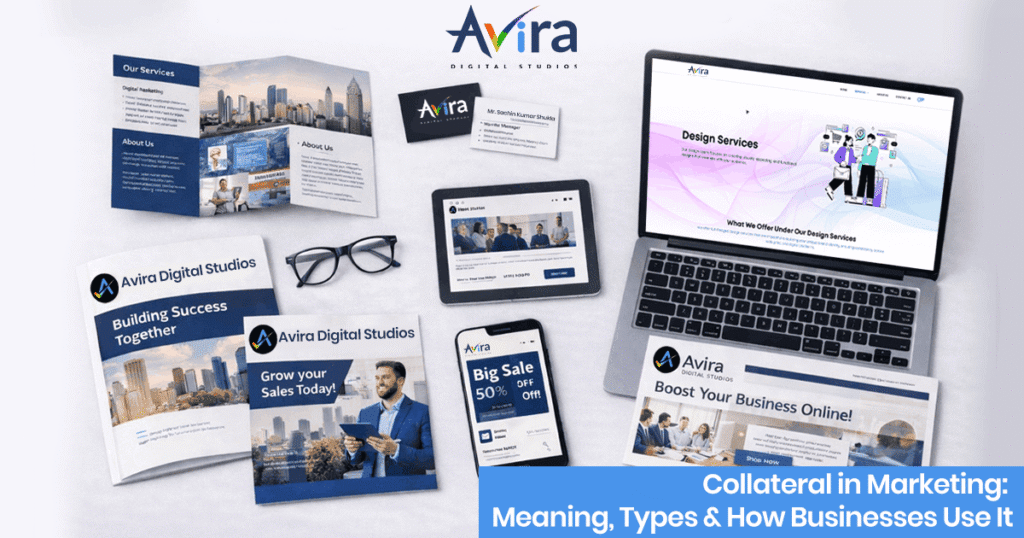
Marketing collateral is the collection of branded assets such as printed, digital, or experiential materials. It is used to communicate value and move buyers toward a decision. Think of it as your sales team’s silent partner; the one that never clocks out.
Unlike a face-to-face pitch, collateral works alone. A brochure resting on a reception desk. A one-sheet tucked into a shipping box. A case study PDF might be opened by a prospect at 11 p.m. when your office is dark. Each piece is engineered not just to inform, but to tilt the odds in your favor.
This is creative collateral, meaning stripped of jargon: persuasive design placed exactly where the customer needs it, exactly when they’re deciding. And when that design is intentional and shaped by research, not guesswork, it becomes creative marketing collateral design. A discipline that marries visual craft with commercial intent.
Why Marketing Collateral is important for businesses
You can own the best product in your category. But if no one can explain why, after you leave the room, you’ve lost the deal before it started. Marketing collateral closes that gap. It turns your message into something clear, tangible, and easy to remember.
It helps businesses:
- Build credibility
- Support sales decisions
- Compete with bigger brands
- Create consistent brand perception
- Reduce buyer hesitation
In short, marketing collateral helps people understand, trust, and choose your business, even when you’re not in the room.
Types of Marketing Collateral
Print Marketing Collateral
Paper demands attention that digital rarely earns.
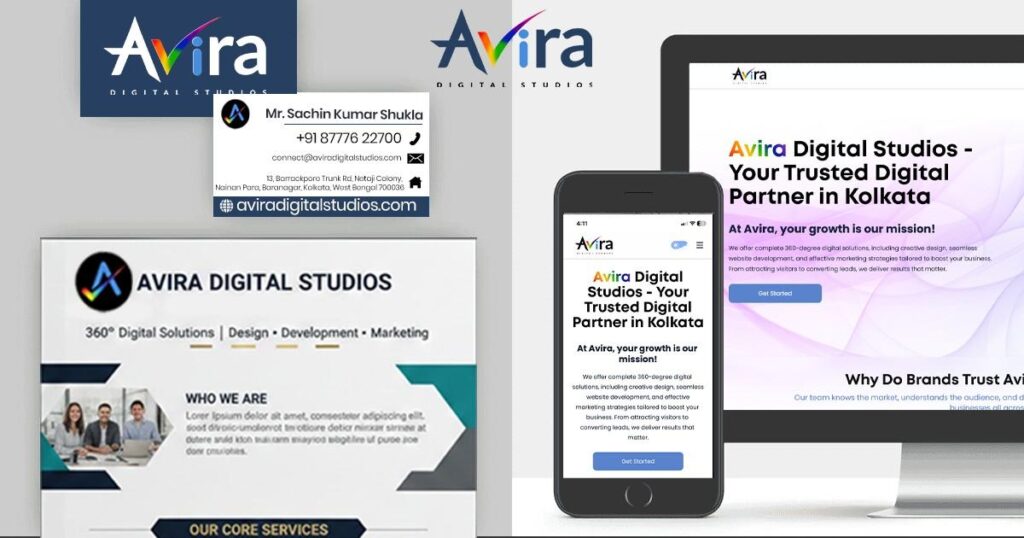
A real estate agent who hands over a trifold with listing photos and neighborhood stats isn’t just sharing information; they’re providing context. She’s handing the buyer something to carry, fold, and revisit. Marketing collateral design in print relies on what screens can’t replicate: texture, weight, and the faint smell of ink. A letterpressed business card or a fabric-swatch booklet for an interior designer; these aren’t handouts but souvenirs.
Digital Marketing Collateral
Digital assets trade tactility for speed and scale.
A B2B software company rarely relies on brochures alone to win enterprise clients. They win with a comparison matrix that loads instantly. An interactive ROI calculator. A white paper that makes the buyer feel smarter for having read it.
What distinguishes creative marketing collateral in digital formats is utility and not decoration. The asset must solve a problem the customer has right now: “Which plan do I choose?” “How do you compare to vendor X?” “What does implementation actually look like?” Answer those, and the asset earns its keep.
How to choose the right Marketing Collateral
Once you understand the different formats available, the next step is deciding which ones actually make sense for your business. Most businesses start with what’s easy, like a logo, a trifold, a social graphic. Then they wonder why the phone doesn’t ring.
Strategy precedes format. Ask first: What does the customer need to believe before they buy? If the answer is “that we’re reliable,” a case study carries more weight than a brochure. If they need to visualize themselves using the product, a video demo or lookbook outperforms a spec sheet.
This is what collateral design really means in practice, and it’s not about what you want to say. It’s about what the buyer needs to hear, and in what order. Map the journey, then build the assets.
Common mistakes businesses make
- Designing for internal taste, not customer perception: Leads to assets that resonate with founders but confuse buyers.
- Using one deck for multiple audiences: Results in messaging that is too generic to persuade anyone.
- Letting collateral go stale: Outdated case studies, retired features, and old pricing erode credibility instantly.
When to hire a Creative Marketing Collateral Design Agency
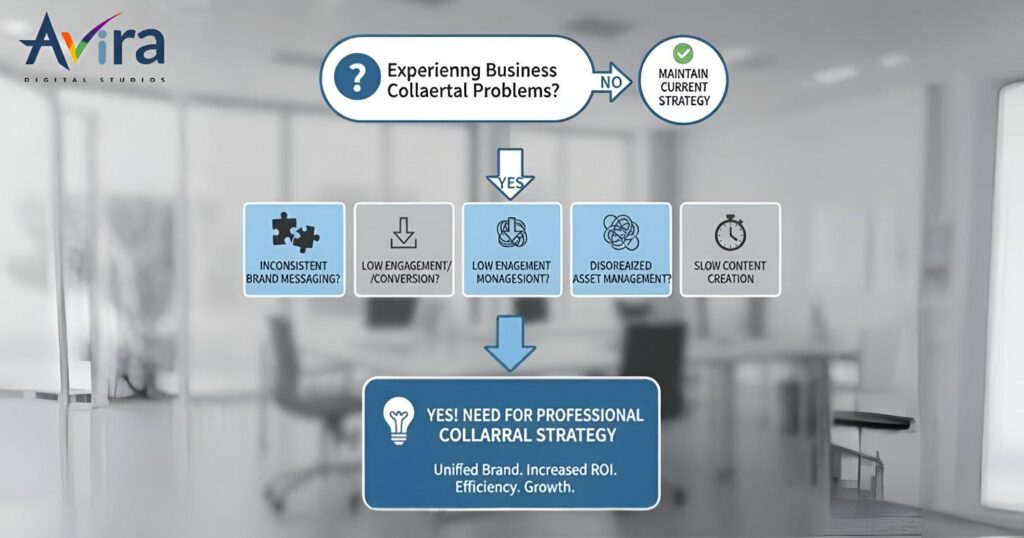
Many growing businesses eventually seek professional support to build a structured collateral system. That’s where creative marketing collateral design from Avira Digital Studios can help.
- When inconsistent assets lose you deals
The pitch deck looks premium. Proposals look like homework. That mismatch signals disorganization.
Hire if: buyers mention “brand feels unfinished” or sales teams spend hours fixing templates.
- When you have files, but no system
Folders full of old logos, half-finished decks, and no single source of truth.
Hire to: build a centralized, scalable collateral system and not rescue a chaotic drive.
- When every sales deck is built from scratch
Each prospect triggers a new Frankenstein deck. Hours wasted and brand voice shifts slide to slide.
Hire for: modular decks that are pre-built, on-brand slides that assemble in minutes, not hours.
- When close rates stall despite a strong product fit
You win demos. You lose signatures. The gap is often communication, not capability.
Hire when: prospects hesitate after seeing materials, or competitors feel “more polished.”
- When growth requires consistency at scale
One-off designs worked for five employees. At fifty, inconsistency becomes liability.
Hire to: ensure a PDF opened in Nepal feels identical to a brochure handed over in New Zealand.
Conclusion
Marketing collateral isn’t just something you create once. It’s something that builds trust with your audience over time.
Some deposits are small, like a social graphic or a product spec sheet. Others are substantial, such as a beautifully bound annual report or an interactive brand microsite. But each one accumulates. Over time, prospects don’t remember a single brochure. They remember the feeling of competence and care that every asset, together, conveyed.
For startups and growing businesses, the goal isn’t to create everything. It’s to create what matters. This is what creative marketing collateral design means at Avira Digital Studios. We help you deposit the right assets, in the right formats, so your brand earns trust before you even speak.
Ready to make your collateral work harder? Contact us today!