You have just launched your Shopify store. You list the products, price them in INR and keep looking at the dashboard for that first order. But no one is ordering after waiting for days. Your store opens, it’s out there on the net somewhere, but Google pretends it’s not.
Most of the new online store owners in India hit this wall. This is precisely the problem that ecommerce SEO is made for.
In this guide, we will simply break down what ecommerce SEO means, why it deserves your attention, and where to start if you’ve never dealt with SEO before in your life.
Table of Contents
What is Ecommerce SEO, exactly?
Ecommerce SEO is simply the work that gets your online store in front of real shoppers when they search for what you sell on Google, without having to pay for each click.
Simple enough. But many people confuse this with regular SEO, and that mix-up costs them a lot of wasted effort.
Regular SEO mostly serves people looking for information. A blog post titled “how to care for silk sarees” is a good example.
Ecommerce SEO serves people who are already close to buying. A product page targeting “buy pure silk saree online India” is ecommerce SEO. The search intent is completely different, and your strategy has to match it.
When someone in Pune types “best face serum for pigmentation under 500 rupees” into Google, the search engine evaluates every relevant page and decides which ones deserve the top spots. Ecommerce SEO is the work that gets your page into that conversation.
Think of Google as a librarian managing a library with billions of books. Your product page is one of them. A vague title, a misplaced shelf, no references from other books, and the librarian won’t recommend yours to anyone. SEO fixes all three.
Same fundamentals apply to Shopify, Myntra and Nykaa. The difference is one of scale, not of principle.
Why SEO matters more than Paid Ads for new store owners
Paid ads are not the problem. A Google Shopping campaign launched today can send real visitors to your store by tonight.
What most people don’t hear upfront is that once the budget runs out, all that traffic vanishes instantly. It’s like renting a market stall. The moment your payment stops, the stall is gone.
SEO compounds differently.
Picture a clothing brand in Jaipur spending Rs 15,000 a month on paid campaigns for “handblock print sarees”. Traffic flows while the money flows. Stop the spend, stop the traffic.
Now imagine that same brand had spent those months doing SEO work. Six months down the line, those same visitors could be arriving for free every single month. That traffic is now an asset, not a rental.
There’s a trust layer here too. When shoppers are about to spend money with a brand they’ve never bought from, many skip the “Sponsored” listings and click organic results instead. Organic visibility often feels more credible.
For store owners in India especially, where margins are often tight and ad costs keep rising, organic search creates long-term stability.
Bottom line: Paid ads rent your traffic; SEO helps you own it.
The core pillars of Ecommerce SEO strategy
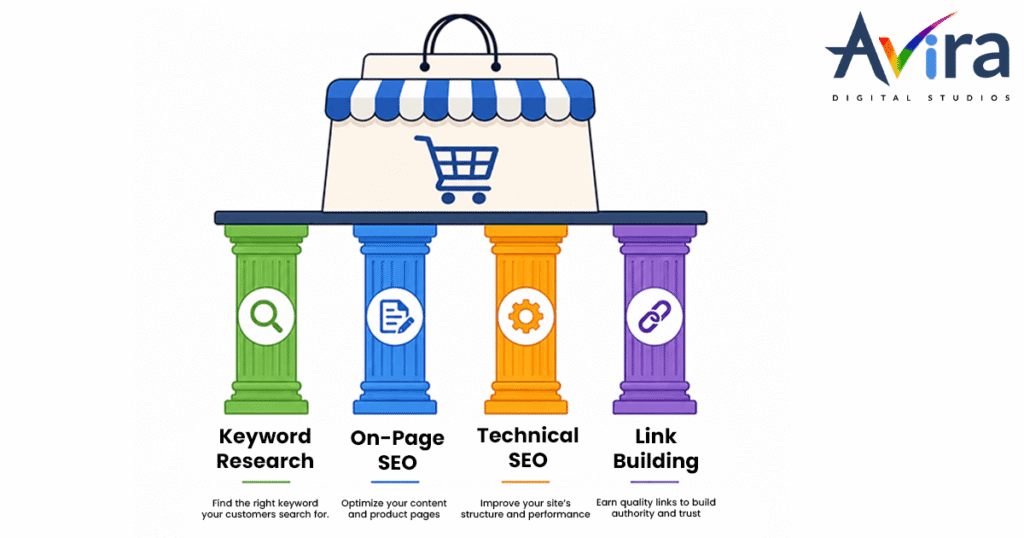
There are four core pillars of a good ecommerce SEO strategy. You’ll never master all four at once, but knowing them will change the way you approach every part of your store.
1. Keyword Research
A keyword is simply what someone types into Google.
Keyword research means finding the exact phrases your customers use instead of guessing what they search for.
For example, if you sell organic skincare, you might think your audience searches:
- “natural face care products”
But real searches often look like:
- “best vitamin C serum for oily skin India”
- “paraben-free moisturiser under 800 rupees”
- “gentle face wash for sensitive skin India”
Those are completely different search behaviours.
If your website is only written in your internal business language, not your customers’ language, Google has difficulty connecting you with buyers. Google Keyword Planner, Ubersuggest and other free tools can help you find keyword opportunities and search volume.
2. On-Page SEO
On-page SEO includes everything you optimise directly on your website pages:
- Product titles
- Product descriptions
- Headings
- Meta descriptions
- Image labels
- Internal links
One of the biggest mistakes new ecommerce store owners make is copying supplier descriptions directly.
Google has usually already seen that exact content on dozens of websites. Duplicate content rarely ranks well.
Even writing a simple original description immediately improves your positioning.
3. Technical SEO
Technical SEO sounds intimidating, but beginner-level technical SEO is mostly about usability.
The biggest issue is usually page speed.
If your product page takes five or six seconds to load on mobile data, many users leave before even seeing the product.
Google notices that behaviour and interprets it as a poor user experience.
Since most Indian ecommerce traffic comes from mobile users, mobile performance becomes critical.
Schema Markup
Schema markup helps Google understand:
- Product name
- Price
- Availability
- Ratings
When implemented correctly, Google can display enhanced search results like:
- Star ratings
- Prices
- Stock availability
Many Shopify themes already include basic schema functionality.
4. Link Building
A backlink is when another website links to your store.
Google treats backlinks like trust signals.
Examples of beginner-friendly link building:
- Business directories
- Lifestyle blog mentions
- Product review features
- Guest posts
- Industry partnerships
These early backlinks gradually improve your website authority.
Technical SEO can feel overwhelming when you’re just starting out, but Google has made its expectations clear. From URL structure to product data, the rules are documented and accessible. If you want to go deeper, Google’s official ecommerce SEO guidelines are the most reliable reference point available, written by the same team that builds the algorithm your store needs to rank on.
The Short Version
All four pillars work together. Ignoring even one creates a ceiling on your growth.
Bottom line: These four pillars work together. Neglecting even one of them limits how far your SEO can take you.
Product Page SEO: Where Most Beginners Get It Wrong
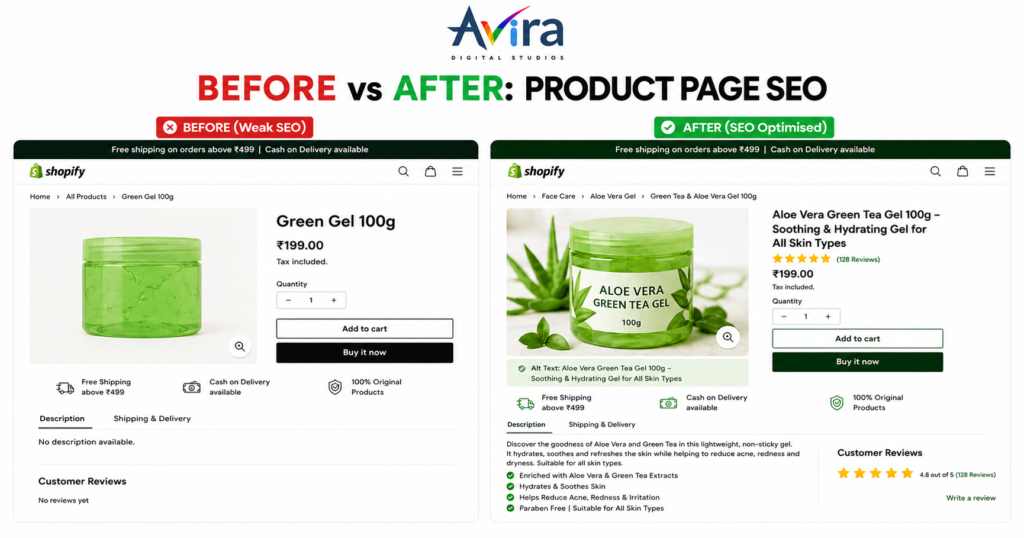
Your product pages are where all that SEO effort converts into actual sales. Yet most new store owners treat them like an afterthought, just a place to dump specs and move on.
Here’s what strong product page SEO actually looks like:
Title tag: “Organic Aloe Vera Face Gel 100g | Soothing & Hydrating | Free Shipping India” specific, keyword-rich, and immediately useful to the person reading it.
Product description: Write for the customer first, Google second. Focus on the benefit, not just the feature. “This lightweight gel absorbs in seconds, making it ideal for humid Indian summers” is far more compelling than “Aloe vera gel, 100g, green colour.”
Image alt text: Google can’t actually see your product photos. Alt text is a short description you add to each image that tells Google what’s in the frame. “Organic aloe vera face gel in glass jar” does real work for your SEO. “IMG_4521” does nothing.
Customer reviews: Reviews refresh your page with new content regularly and naturally introduce the kind of language real buyers use when they search. Actively encourage customers to leave them.
A small organic skincare brand from Bengaluru revised their product descriptions with intent-specific keywords and experienced a 40% increase in organic clicks in three months – no backlinks, no paid promotion. Simply better copy.
Common Ecommerce SEO Myths Worth Dropping
Myth 1: “SEO takes years so there’s no point starting now.”
Basic on-page improvements can show results in weeks, not years. Full domain authority takes time, that part’s true. But every consistent improvement you make starts building immediately. The stores that wait until they feel completely ready are usually the ones still depending entirely on paid ads two years later.
Myth 2: “Stuffing keywords everywhere means better rankings.”
It doesn’t. And it hasn’t for a long time. Google’s algorithm is sophisticated enough now to know when a page was written for a bot instead of a buyer. Use keywords where they really fit naturally and leave them out where they don’t.
Myth 3: “I already sell on Amazon and Meesho, so I don’t need my own website.”
Marketplaces can raise their commission structure, change their algorithm, or remove your listings at any point. And frequently they do. Your own website with solid ecommerce SEO gives you traffic you actually own, customer data you can use for remarketing and email, and a brand identity that no platform policy can wipe out.
Myth 4: “Writing a good meta description improves my Google ranking.”
Meta descriptions don’t directly affect rankings. What they do affect is how many people click your result when it does appear. A clear, specific meta description can noticeably improve your click-through rate even from position four or five. That CTR improvement can, indirectly, help your rankings over time. But the direct effect on ranking is close to zero.
Your first 5 steps to start with Ecommerce SEO
Here’s exactly where to focus if you’re just getting started:
1. Set up Google Search Console (it’s free). It shows you which keywords your site already appears for, which pages Google has indexed, and any technical errors it’s found.
2. Research 10 to 20 high-intent keywords for your products. Use Google’s autocomplete suggestions and the “People also ask” section on results pages, both are full of real buyer language.
3. Rewrite your top 5 product page titles and descriptions using your target keywords naturally, not forced in, but woven in where they make sense.
4. Compress your product images before uploading. Free tools like TinyPNG can cut load times significantly, which has a direct impact on your rankings.
5. Add alt text to every product image on your store. It takes about an hour and most competitors skip it entirely.
You don’t need to do everything at once. Consistent, small improvements build up faster than you’d expect.
Getting Ecommerce SEO right in 2026
Google’s content quality updates over the past couple of years have settled something that used to be debated. Thin pages with copied descriptions and generic product content don’t hold rankings anymore. What holds is depth, real usefulness to the shopper, and a store experience that Google trusts.
For Indian ecommerce store owners, honestly, this is a good moment. Search volumes for product-specific queries, regional language searches, and vernacular terms are growing faster than the supply of well-optimised content. Smaller product niches especially, traditional crafts, regional foods, niche wellness categories, have very little real SEO competition. Getting your fundamentals right now means you’re building a lead that compounds.
SEO isn’t a project that ends. It’s a habit you build into how you run the store week to week. The earlier that habit forms, the more it compounds over time.If you’re running an online store in India and want expert support building an ecommerce SEO strategy that actually brings in buyers rather than just traffic numbers, Avira Digital Studios works with Indian ecommerce brands at every stage of growth. Take a look at what we offer and get in touch if you’d like a proper look at where your store stands right now.