You’ve got a website. Maybe you spent months getting it right. But when you search for your own business… nothing. A few pages in, maybe a mention. It’s frustrating.
Here’s the thing, you’re not alone. Most business owners assume that once a site is live, people will find it. Search engines don’t work that way. They need signals. They need to trust you. And that trust is built through something called SEO.
By the end of this blog, you’ll understand how search engines really work, what’s changing in 2026, and exactly where to focus your energy. No fluff, just a practical roadmap. Let’s start with what SEO actually means today. This complete SEO guide 2026 is designed to simplify everything, especially if you’re looking for an SEO guide for beginners.
If you’re searching for SEO services in India, Avira Digital Studios helps businesses like yours cut through the noise with strategies that actually deliver.
Get your free consultation today
Table of Contents
What is SEO and how it works step by step
Search engine optimization is simply the practice of making your website visible when someone searches for something related to your business. Sounds simple. But most people get it backward, they try to please Google instead of helping the person behind the search. Understanding how search engines work is the foundation of everything in SEO.
When you help people, Google notices.
How search engine optimization works for beginners
Think of search engines like librarians. When you walk into a library and ask a question, the librarian needs to know which books have the answer. Search engines do the same thing using three processes.
Crawling comes first. Automated bots, called crawlers, follow links across the web. They move from page to page, discovering new content and checking for updates. If your site isn’t crawlable, they’ll never find you.
Indexing is what happens next. Once a crawler visits your page, the search engine analyzes it. Text, images, structure, all of these get stored in a massive database called the index. No indexing means your page doesn’t exist on Google.
Ranking is the final piece. When someone types a question, the search engine pulls from its index and ranks the results based on hundreds of factors like relevance, authority, and user experience.
How google ranking works for websites
Google’s algorithm looks at three broad things: relevance, authority, and usability. These are part of what we call Google ranking factors.
Relevance means your content matches what people are searching for. Authority comes from other trusted websites linking to you like votes of confidence. Usability covers everything from page speed to whether your site works on a phone.
No single factor decides your ranking. Google looks at the whole picture. The pages that rank highest are the ones that genuinely satisfy what people need.
Types of SEO you must know
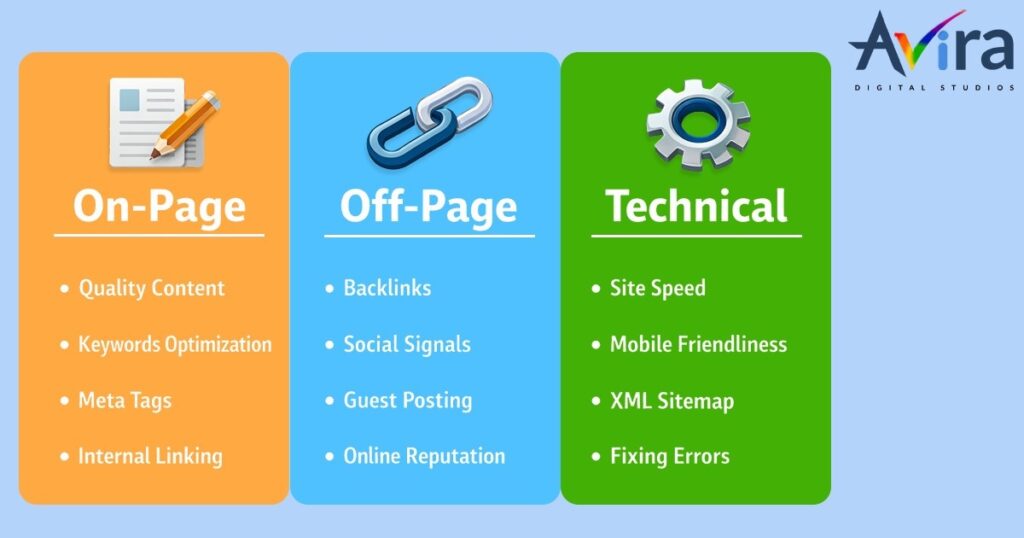
SEO isn’t one thing. It’s three interconnected parts, and each one plays a role. Ignore one, and your results will suffer.
On-Page SEO
On-page SEO techniques cover everything you control directly on your pages. This includes content, keywords, headings, internal links.
The basics:
- Title tags that describe the page and include relevant terms
- Headings that break content into digestible chunks
- Content that actually answers questions
- Image optimization with descriptive file names and alt text
- Internal links connecting related content
Get these right, and search engines understand your content better.
Off-Page SEO
Off-page SEO happens away from your website. The main player here is backlinks, that is links from other sites pointing to yours.
When a reputable site links to you, it’s like a referral. Google takes that as a sign of trust. But not all links are equal. A link from a respected industry publication matters far more than dozens of links from spammy directories.
The best way to earn backlinks is to create content worth linking to. Engage with your community and build genuine relationships as there are no shortcuts here.
Technical SEO
Technical SEO basics form the foundation of your website’s performance. It’s all behind-the-scenes work that helps search engines crawl and index your site properly.
Key pieces:
- Site speed: Pages should load in under a few seconds
- Mobile responsiveness: Your site must work on phones
- HTTPS: Security matters to both users and Google
- XML sitemaps: A roadmap telling search engines which pages matter
- Crawlability: Can Google access everything?
If your technical SEO is broken, nothing else works as well. Without it, even great content struggles to perform. We offer SEO services in India tailored to modern search trends, helping you move in the right direction.
To get a clearer picture of your current performance, contact us for a free website audit.
Step-by-step SEO strategy for new websites
Every effective SEO strategy for business starts with a structured approach. Starting from scratch? Here’s a phased approach that works.
Phase 1: Get the basics right.
Set up Google Search Console and Google Analytics. These tools are free and tell you how Google sees your site. Submit your XML sitemap. Make sure your site loads quickly on mobile. These aren’t optional.
Phase 2: Understand what people search for.
Keyword research isn’t about finding high-volume terms. It’s about understanding what your potential customers actually type. This is where proper keyword optimization plays a key role. Focus on longer, specific phrases. Someone searching for “best accounting software for freelancers in Mumbai” is much closer to buying than someone searching just “accounting software.”
Phase 3: Create content that helps.
Write for humans first. Answer questions thoroughly. Organize information clearly. Show your experience. Google’s E‑E‑A‑T (Experience, Expertise, Authority, Trust) now plays a huge role in rankings.
Phase 4: Connect your content.
Use internal links to connect related pages. If you’ve written about one topic, link to other relevant content. This helps search engines understand your site structure and keeps people reading longer.
Phase 5: Be patient.
New websites don’t rank overnight. Google needs time to discover, crawl, and evaluate your content. Consistency matters more than perfection.
How to improve website ranking on Google organically

Organic improvement means earning visibility without paying for ads. Here’s what actually moves the needle.
- Match search intent: Before optimizing any page, ask: what does someone want when they search this term? If they’re looking for information, a product page won’t satisfy them. If they’re ready to buy, a beginner’s guide won’t convert. Give people what they actually need.
- Structure for humans: People scan web pages. Use short paragraphs. Break content with headings. Use bullet points for key information. When your content is easy to consume, people stay longer, and search engines notice.
- Build topical authority: Instead of writing isolated articles, create clusters around core subjects. A pillar page covers a broad topic. Supporting articles dive into subtopics. This approach signals expertise.
- Earn links naturally: Backlinks remain powerful, but they have to be genuine. Create content worth linking to. Share your expertise. Build real relationships. Paid or spammy links will eventually hurt you.
All of this contributes to better website visibility improvement over time. In our experience working with different industries, websites that focus on clarity, structure, and real value tend to perform better over time.
Best SEO strategies for small businesses in 2026
Small businesses have different constraints such as limited budgets, fewer resources, bigger competitors. Many small businesses today rely on SEO services in India to compete with larger brands without overspending on ads. You know your customers better. You can move faster.
Claim your Google Business Profile. If you serve local customers, this is non-negotiable. Your profile shows up in local search and on Maps. Keep it accurate. Add photos. Respond to reviews.
Target question-based keywords. People ask questions constantly like “how do I,” “what’s the best,” “why does.” AI search engines like ChatGPT and Perplexity are built to answer questions. When your content directly answers those, you become a candidate for citations.
Show real experience. E‑E‑A‑T is now a core ranking factor. Show your hands-on experience. Share case studies. Include author bios that demonstrate expertise. Content from people who’ve actually done the work outperforms generic writing.
Build your reputation. Your reviews, mentions, and how people talk about your brand all influence search visibility. A strong reputation isn’t just good for business, it directly impacts how search engines perceive you.
If you’re just getting started, you can explore this SEO guide for businesses in Kolkata, “Unlock The Power of SEO: A Guide for Business Owners in Kolkata“
How to increase organic traffic to your website
The goal is long-term organic traffic growth, not short spikes. Organic traffic comes from people finding your site through unpaid search. It’s valuable because it represents genuine interest.
- Answer questions directly. Most searches start with a question. When your content clearly answers those questions, you become visible to people looking for solutions. Put answers early in your content and make them easy to find.
- Update older content. Content gets stale, statistics change and products evolve. Regularly refreshing your existing content signals to Google that you maintain high standards. It also gives you a chance to improve pages that are already ranking.
- Optimize for featured snippets and AI Overviews. Zero-click searches, that is where users find answers directly on search results pages, now account for nearly 60% of Google searches. Being visible in featured snippets, AI Overviews, and knowledge panels matters as much as your ranking position.
- Build a content ecosystem. One article has limited impact. When you create interconnected content around core topics, each piece supports the others. Internal links connect everything, helping both users and search engines understand your expertise.
How AI is changing SEO in 2026
AI has fundamentally shifted how people search. If you’re still thinking only about Google’s ten blue links, you’re missing the bigger picture.
Search happens everywhere.
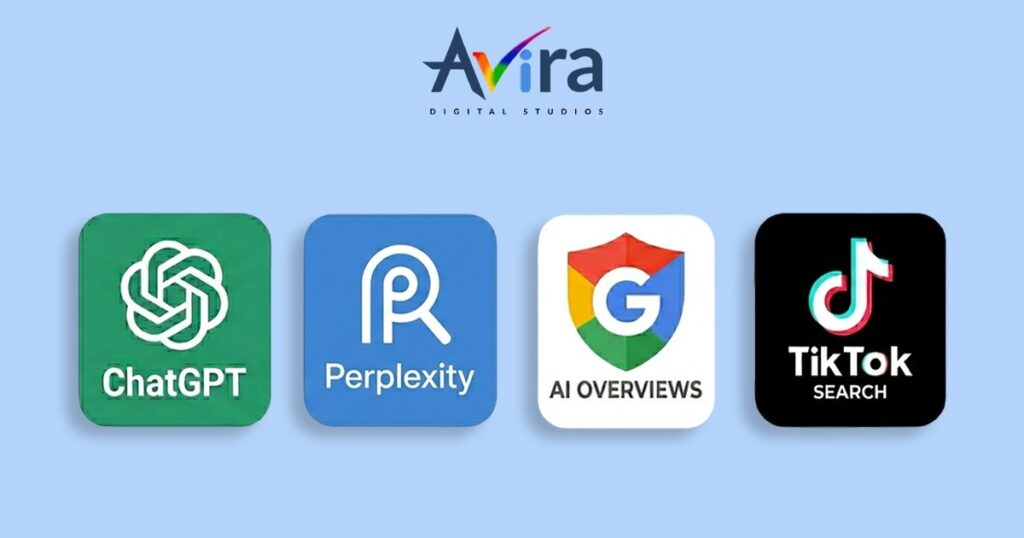
Your customers are asking questions on ChatGPT, Perplexity, TikTok, and Reddit. AI-powered search engines pull information from multiple sources and synthesize answers before showing traditional links. If your content isn’t visible in these new environments, you’re losing opportunities.
Keywords matter less; intent matters more.
AI systems now understand what someone means, not just what they typed. Stuffing content with exact-match keywords doesn’t work. What matters is whether your content genuinely answers the question behind the search.
E‑E‑A‑T is a gatekeeper.
Experience, Expertise, Authority, Trust, these aren’t just guidelines anymore. They’re core ranking signals. Content without real-world credibility will struggle to rank.
Google AI Overviews change visibility.
These AI-generated summaries appear at the top of many search results. They pull information from multiple sources. Structure your content with clear headers, Q&A formatting, and quotable statements to increase your chances of being featured.
What is AEO and GEO in SEO explained
As search evolves, two new concepts have emerged.
Answer Engine Optimization (AEO) focuses on making your content the direct answer to user questions. Traditional SEO aims to get your page in the top three results. AEO aims to have your content featured in the answer block, whether that’s a featured snippet, AI Overview, or voice search result.
To do this, understand the common questions in your industry. Answer them clearly. Use question-based headings. Provide complete responses without forcing readers to click elsewhere for the full picture.
Generative Engine Optimization (GEO) addresses AI-powered search platforms like ChatGPT, Perplexity, and Google’s AI Overviews. These engines don’t just list links, they synthesize information from multiple sources and generate original responses.
GEO is about making your content more likely to be cited as a source in AI-generated answers. Create comprehensive, authoritative content structured in ways AI systems can easily interpret. When AI tools recommend your business or cite your content, you gain visibility even without clicks.
Practically, both come down to the same thing: create well-structured, authoritative content that answers questions directly. That works for traditional search and AI platforms alike.
For a deeper dive into how SEO, AEO and GEO work together, read this blog, “How SEO, AEO & GEO Work Together—Expert Insights from Avira Digital Studios“
SEO vs Paid Ads – which is better for long-term growth?
People ask this constantly. The answer depends on your goals.
Paid ads give you speed.
Launch a campaign today, see traffic tomorrow. That’s valuable for product launches, seasonal promotions, or testing offers. You control exactly who sees your ads and what they see.
But there’s a catch. When the budget stops, the traffic stops. In competitive industries, cost per click adds up fast. You’re renting visibility, not owning it.
SEO builds assets.
When a page ranks well, that visibility persists without ongoing per-click costs. A single well-optimized article can drive traffic for years.
The tradeoff is time. New websites typically need 3–6 months before seeing meaningful organic traffic. You trade speed for sustainability.
The smart play is both.
Use paid ads to validate offers, drive immediate traffic, and capture demand while SEO builds. Use SEO to build sustainable visibility that reduces dependence on ad spend over time.
For most businesses, SEO delivers better long-term value because it builds assets. Paid ads give you flexibility and speed. Together, they create a balanced growth strategy.
If you want a deeper comparison, read this blog that explains the difference of SEO and paid ads clearly, “SEO vs Paid Ads: Which Strategy Brings Long-Term Results for Your Business?“
Common SEO mistakes to avoid
Even experienced marketers fall into these traps. You need to avoid these SEO mistakes:
- Targeting keywords with no business value.
High traffic doesn’t matter if those visitors never become customers. Focus on keywords that align with what you actually sell or the problems you solve.
- Ignoring search intent.
If someone searches for “best coffee makers” and your page only reviews budget options, you’re not satisfying the intent. Research what people expect, then deliver exactly that.
- Creating thin content.
Pages with minimal text, no depth, and little value won’t rank. Each page should serve a clear purpose and provide enough substance to genuinely help someone.
- Neglecting technical basics.
A beautiful site that loads slowly on mobile or has broken links frustrates both users and search engines. Technical SEO creates the foundation for everything else.
- Building spammy backlinks.
Paid links, link exchanges, and low-quality directory submissions might show short-term gains, but they risk penalties that can destroy your visibility. Earn genuine links through quality content and real relationships.
- Forgetting about mobile.
Over half of searches happen on mobile devices. If your site isn’t responsive and fast on phones, you’re losing opportunities, like no matter how good your content is.
SEO best practices for 2026
Core principles remain, but priorities have shifted. These SEO best practices 2026 reflect how search is evolving.
- Write for people first: Forget algorithms and write content that genuinely helps readers. That naturally satisfies ranking factors.
- Structure for both humans and AI: Use clear headings. Organize information logically. Answer questions directly. This helps both people scanning your page and AI systems extracting information.
- Demonstrate real expertise: Author bios, case studies, original research, detailed guides, these all signal experience. Content from people who’ve actually done the work outperforms generic writing.
- Build topical authority: Instead of publishing random articles, develop deep coverage of subjects relevant to your business. Topic clusters like pillar pages with supporting content, signals expertise across entire subject areas.
- Monitor your reputation: Reviews, mentions, and how people discuss your brand influence search visibility. Actively manage your reputation across platforms.
- Optimize for zero-click visibility: Featured snippets, AI Overviews, knowledge panels, as they matter as much as traditional rankings. Structure content so it can appear in these formats.
- Stay consistent: SEO rewards patience and steady effort. A manageable schedule maintained over months beats bursts of activity followed by silence.
This is why many brands turn to SEO services in India to implement these practices effectively.
FAQs
1. What is SEO and how does it work step by step?
SEO stands for search engine optimization, it means helping your website show up when people search for things you offer. Search engines send out little bots that crawl the web, moving from link to link. When they find your page, they read it and store it in their library and that’s called indexing. Then, when someone types a question, they pull from that library and rank the results. Relevance, trust, and user experience decide who ends up on top.
2. How can I improve my website ranking on Google?
You can improve website ranking by writing content that actually helps someone. Make sure your site doesn’t feel slow on a phone, because that’s how most people browse now. Then work on building your reputation, which usually means getting other reputable sites to link to you. And keep things organized: clear headings, easy-to-follow structure. Update old posts too. It’s a mix of things that add up over time.
3. What are the best SEO strategies for beginners?
Set up Google Search Console as it tells you what Google thinks of your site. Make sure your site works on mobile because, honestly, if it doesn’t, you’re invisible. Then spend time figuring out what people actually search for when they’re looking for a business like yours. Write one solid piece of content that answers a specific question. Link it to other pages you’ve written.
4. How long does SEO take to show results?
Most new websites take anywhere from 3 to 6 months to see steady organic traffic. Sometimes you’ll notice a small change in a few weeks, especially if you fix something technical that was broken. But to really build authority and rank for competitive terms, you’re looking at consistent effort over a longer stretch. Anyone promising faster than that is probably selling shortcuts that won’t last.
5. Is SEO better than paid ads?
It depends on what you need right now. Paid ads get traffic the same day, but the moment you stop paying, it dries up. SEO is more like planting a tree. It takes time to grow, but once it’s established, it keeps bringing visitors without a per-click cost. Most businesses do best by using both: ads to get quick wins while SEO builds something sustainable underneath.
Conclusion
We’ve been around this long enough to know that SEO gets overcomplicated on purpose. People sell fear. They make you think you need to outsmart Google with tricks or chase every algorithm update like it’s breaking news.
But the truth is simpler than that.
SEO is really just about answering the questions people are already asking and making it easy for them to find your answers. When you focus on helping real people, showing what you actually know, and keeping your site from getting in the way, search engines tend to reward you. That hasn’t changed, even with AI reshaping how search works.
If you’re tired of guessing and ready to build something that actually lasts, Avira Digital Studios works with businesses to do exactly that. We’ve been helping clients figure out modern SEO, the stuff that works now, not five years ago.
If you’re looking for SEO services in India that focus on real results instead of buzzwords, reach out. Let’s figure out what makes sense for your business, get in touch with us today.