
A parent leaves the office at 7 pm, opens Google on her phone and types “ICSE school near Salt Lake”. She taps two results, skims the reviews, looks for the fee page and sends one WhatsApp message. By 9 pm her shortlist has three names. Your school either made that list or it didn’t, and nobody will tell you which.
A digital marketing strategy for schools has one job: win that evening, then win the reply that follows it. Below is the order to work in, from the Google listing parents see first to the WhatsApp reply that brings them to your campus.
What is digital marketing for schools?
Digital marketing for schools is the planned use of Google search, Maps, social media, paid ads and WhatsApp to bring parents to your admissions desk and keep them moving until they enrol. It works when every channel feeds one enquiry process instead of running on its own.
Table of Contents
A digital marketing strategy for schools starts with how parents decide
Parents don’t pick a school from a single source. They run a loop. First comes search, usually on a phone, usually with a board and a locality in the query, like “CBSE school in New Town” or “play school near me”. Then proof: Google reviews, Instagram, a YouTube walkthrough, and the parent WhatsApp groups where one blunt comment can outweigh your whole brochure. Then the enquiry, by form, call or message. Then the campus visit. By the time a parent walks in for a visit, she has usually watched your walkthrough and read plenty of reviews, so she arrives half decided.
Most schools spend heavily on the first step and leak parents at the third. Fixing the leak costs less than buying more traffic, and the sections below follow that logic.
Start with Google Business Profile and local SEO for schools
If your budget is tight, a digital marketing strategy for schools should begin here. Parents search by board and neighbourhood, and the Maps listing is often the first thing they see.
Claim your Google Business Profile for schools and fill every field: the right category, phone number, timings (including admission office hours), a link to the admissions page rather than the home page, and real photos of classrooms, the playground, the bus and the gate. Stock photos get ignored. Then pick up a phone, stand in a nearby locality and search your own school name and “school near me”. Whatever shows up is what parents see.
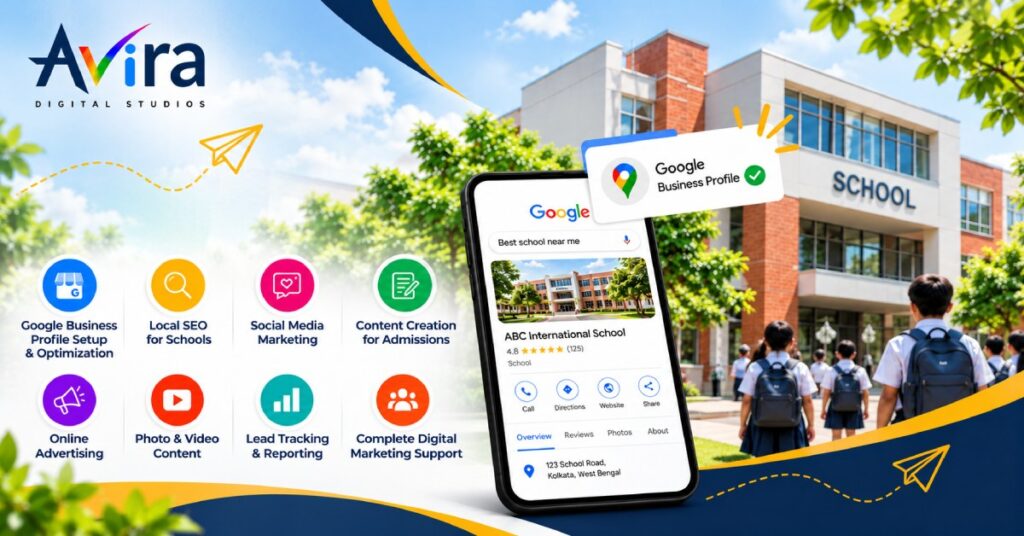
Keep your school’s name, address and phone number identical everywhere, from the website footer to Facebook to school directories. When these details disagree, Google gets unsure which one is right, and so do AI answer tools that pull from several sources.
Ask for reviews in a steady trickle, not a burst. A short WhatsApp with the review link, sent after a parent-teacher meeting or an event, works better than a notice in the diary. Reply to every review, including the angry ones, politely and with specifics. Prospective parents read your replies closely.
On the website, build pages around real queries: admission process and dates, fee structure, board and curriculum, transport and safety, results. Mark the school up with School or EducationalOrganization schema so search engines read your board, address and contact details correctly. If you draw families from several neighbourhoods, add a short page for each one, but only when you have something real to say, like bus routes, travel time and a parent’s quote.
Write content that answers what parents ask your admissions desk
Open your WhatsApp inbox and call log. The same ten questions are in there. Is there transport to Behala? What’s the nursery fee? What’s the teacher to student ratio? Is the school CBSE or ICSE, and up to which class? Write one page for each. Put the direct answer in the first two lines, then add detail underneath. That format gets pulled into Google’s featured answers and quoted by AI tools, and it also happens to be what a worried parent wants.
Skip the usual school marketing ideas like generic parenting tips. They attract readers who aren’t choosing a school this year. Spend that effort on a two minute campus walkthrough by the principal, filmed on a phone in daylight, and on parent stories with real names and photos (with permission). And publish your fees. A school that hides them makes parents call, and plenty of parents simply move on.
Use paid ads for school admission marketing, and send them somewhere useful
Google Search ads catch parents who are already typing “admissions open” with a class and a locality. Meta ads on Facebook and Instagram reach families inside a radius around your campus and bus routes. Concentrate spend in the weeks before your admission window instead of spreading it evenly across the year. Windows differ by city and class, so check your own past enquiry dates before you set a calendar.
Send clicks to a dedicated landing page with one form that asks for parent name, phone number and the class applying for. Nothing more. Add negative keywords early, because a broad term like “school admission” will pull in people hunting for teaching jobs, ERP software and board results, and you’ll pay for each of those clicks. Add retargeting for visitors who opened the fee page and left. And buy only the enquiries you can answer. If your team can handle 30 a day, a campaign that brings 90 will waste 60 of them.
Reply in minutes, then track every enquiry
Speed decides more admissions than most schools admit. Set up WhatsApp Business with quick replies for the greeting, admission process, fee sheet and campus visit booking. Give one person on each shift the job of answering, and aim for a first reply within the hour during office time.
Keep a simple tracker, even a shared sheet, with a status for every enquiry: new, called, visit booked, visited, applied, admitted. Add a column for the source: Maps, Google ad, Meta ad, referral, walk-in. After a month you will know which channel produces admissions and which one only produces phone numbers.
Measure cost per admission, not clicks
Judge your digital marketing strategy for schools by four numbers: cost per enquiry, enquiry to visit rate, visit to admission rate, and cost per admission.
Here is an illustration with round numbers, not a benchmark. A school spends ₹60,000 and gets 120 enquiries, so each enquiry costs ₹500. Thirty families visit the campus, a 25% visit rate, and nine take admission. That works out to roughly ₹6,700 per admission. If the visit rate is the weak number, the problem is follow-up, not ads, and more spend won’t fix it.
Also watch the free data. Calls and direction requests in your Google Business Profile, and clicks and queries in Google Search Console, show whether local SEO is working long before an admission is recorded.
A 90 day school marketing plan
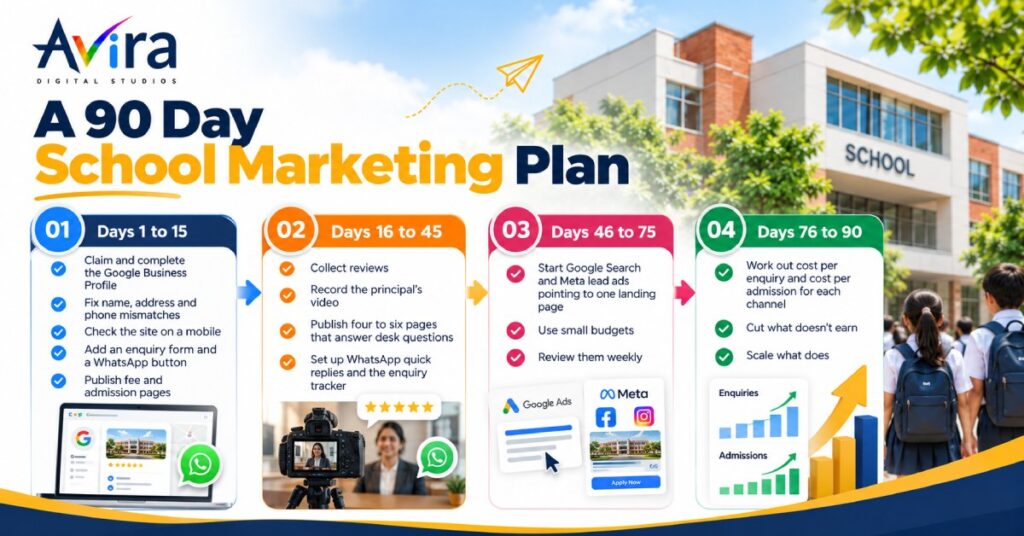
Here is a 90 day version of a digital marketing strategy for schools that a small team can run.
- Days 1 to 15: Claim and complete the Google Business Profile, fix name, address and phone mismatches, check the site on a mobile, add an enquiry form and a WhatsApp button, and publish fee and admission pages.
- Days 16 to 45: Collect reviews, record the principal’s video, publish four to six pages that answer desk questions, and set up WhatsApp quick replies and the enquiry tracker.
- Days 46 to 75: Start Google Search and Meta lead ads pointing to one landing page, with small budgets. Review them weekly.
- Days 76 to 90: Work out cost per enquiry and cost per admission for each channel. Cut what doesn’t earn, then scale what does.
Where to start
Digital marketing for schools doesn’t need to be everywhere. It needs to be easy to find, easy to trust and quick to answer. Fix the Maps listing, publish what parents ask, reply fast and count admissions instead of clicks.
If you’d like a second opinion, Avira Digital Studios, a digital marketing agency in Baranagar, Kolkata, can review your website, local listings and enquiry flow, and map a plan to your admission calendar. Send us your school’s website and we’ll show you where parents are dropping off.
Frequently asked questions
Q: What is the best digital marketing strategy for schools?
A: Start with local SEO and a complete Google Business Profile, then add parent-focused website pages, WhatsApp follow-up and seasonal paid ads. Measure cost per admission, not clicks. This order works because parents search by board and locality first, and most enquiries are lost in slow follow-up, not low traffic.
Q: How much should a school spend on digital marketing?
A: There is no fixed figure. Work backwards from your admission target: decide how many seats you need to fill, estimate your enquiry to admission rate from past data, and set a budget that produces that many enquiries at an acceptable cost per admission. Start small, review monthly and scale what brings admissions.
Q: How long does SEO take to bring school admissions?
A: Fixes to a Google Business Profile can show movement within a few weeks. Website SEO usually takes three to six months to show steady results, and longer in competitive localities. Admission seasons are short, so start at least one term before your enquiry peak.
Q: Is Google Ads or SEO better for school admissions?
A: They do different jobs. Google Ads brings enquiries quickly in admission season but stops when the budget stops. SEO and a strong Maps listing build steady enquiries over time at a lower cost. Most schools do best with SEO as the base and ads added for peak weeks.
Q: How can you increase school admissions without spending on ads?
A: Complete your Google Business Profile, ask happy parents for reviews, publish fee and admission pages, and reply to every enquiry within an hour. Add a parent referral habit, such as a shareable WhatsApp message after every campus visit. These cost time, not ad budget.